Key facts
- Founded
- 1941
- Founded by
- Willys-Overland
- Country
- United States
- Headquarters
- Toledo, Ohio, United States
- Parent company
- Stellantis
- Famous models
- Wrangler, Grand Cherokee, Cherokee, Gladiator
- Website
- www.jeep.com
Jeep Logo Meaning: What Does the Symbol Stand For?
The Jeep logo is a wordmark with no picture, animal or emblem beside it, and it carries no official hidden meaning. What it stands for is the name itself, and even the origin of that name is disputed (see what Jeep stands for below).
The Jeep symbol most people recognize is not the logo at all. It is the front of the vehicle: the seven-slot grille set between two round headlights. Some logo sites draw it as a small icon of seven vertical bars between two circles, but no official source we found calls that icon a logo.
What makes up the Jeep logo today:
- The wordmark: the name alone, used since 1993 with no shapes around it.
- The typeface: a bold Helvetica-style sans-serif.
- The grille-and-headlights icon: the unofficial symbol, taken from the seven-slot grille.
Jeep Logo History and Evolution
Jeep logo histories list six main versions since 1941, though the first one is poorly documented. Most of the Jeep logos arrived with a new owner or company name: Kaiser Jeep in 1963, American Motors in 1970 and Chrysler in 1987.
1941–1945: The Wartime Lettering (Poorly Documented)
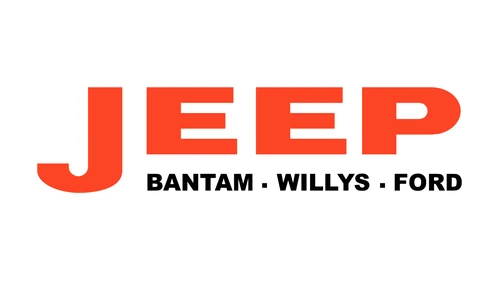
Many logo histories show a 1941 design with Jeep in large red capitals and an oversized J, above a smaller black line reading “Bantam. Willys. Ford.” Treat it with caution: Jeep was not yet an official brand, no Jeep-branded vehicle was built until the 1945 Willys CJ-2A, and one source shows the lettering in black and white.
The wartime jeeps carried their makers’ names instead. Willys stamped its name on body parts and Ford stamped an “F” on components until the government objected and both stopped in 1942.
What changed: nothing yet. It is the only version that names three companies.
1945–1963: The Old Jeep Logo in Quotation Marks
After the war, Willys-Overland put the word in quotation marks: “Jeep” in black, title case, in an extra-bold serif with thin, stretched serifs. Willys used the name in its 1945 branding while its trademark application was still pending, and the quote marks were dropped later. Kaiser Motors bought Willys-Overland in 1953 and kept the lettering.
What changed: the maker names disappeared, and a serif face replaced the sans-serif capitals.
1963–1970: The Round Kaiser Jeep Badge
In 1963 the company was renamed Kaiser Jeep Corporation, and the logo became a round badge. A thick silver ring frames four segments split by silver lines, and “Jeep” in serif type runs across a cream band in the middle.
Most logo archives give the segments as red and gold, and the badge shown here uses red-orange and gold; MotorTrend says red and blue, so the colors are disputed. Some histories tie the badge to the Wagoneer, launched the same year.
What changed: the only circular Jeep logo so far.
1970–1987: The Red Triangle and Blue Rectangle (AMC Era)
American Motors bought Kaiser’s Jeep business in 1970, and Jeep became Jeep Corporation, a wholly owned AMC subsidiary. The logo turned geometric: a bold black sans-serif “Jeep” beside a red triangle whose corner touches a blue rectangle. Logo histories say AMC adopted this symbol for Jeep.
Logopedia alone splits the era in two, with custom lettering from 1970 and a Helvetica Black wordmark from about 1976; other sources treat 1970 to 1987 as one logo.
What changed: the circle gave way to flat shapes, and the sans-serif lettering still used today appeared.
1987–1993: The Old Chrysler Symbol, the Pentastar
The old Chrysler symbol is the Pentastar, a five-pointed star inside a pentagon that Chrysler introduced in 1962 and also used for Dodge, Plymouth and Mopar. Chrysler bought AMC in 1987, chiefly for Jeep, the only AMC brand it kept, sold through its Jeep-Eagle division.
The corporate Jeep logo put a white Pentastar above a white wordmark inside a black rounded square. On the vehicles, MotorTrend notes, buyers usually saw only the plain Jeep wordmark.
What changed: the owner’s star replaced the red and blue shapes.
1993–Today: The Current Jeep Wordmark
In 1993, the year the Grand Cherokee arrived, the Pentastar and every other shape were removed and the wordmark was left on its own. It appears in khaki or olive green, or in black; MotorTrend says green led for a few years before black took over.
This is still the current Jeep logo. There is no new Jeep logo: the lettering has barely changed since the 1970s, only the shapes around it.
What changed: everything except the name was stripped away.
What Does Jeep Stand For? How the Jeep Got Its Name
Jeep does not officially stand for anything. It is not an acronym, and historians have never settled where the word came from. Here is how the Jeep got its name, as far as the record shows, with the main theories of the Jeep name origin:
- Army slang (documented): “jeep” was already US Army slang in World War I for new recruits and for vehicles that had not yet proven themselves. Minneapolis-Moline tractors were being called jeeps by 1937.
- The “GP” theory (popular, unproven): one theory holds that the Army’s GP designation was slurred into “jeep.” Historians have found no early evidence of the vehicle being called GP before this explanation took hold.
- Eugene the Jeep (possible): others point to Eugene the Jeep, a magical creature introduced in E. C. Segar’s Popeye strip, Thimble Theatre, in March 1936.
- Joe Frazer’s claim: Willys-Overland’s president from 1939 to 1944 said he coined the word himself.
The name reached the public in early 1941. Willys drove its vehicle up the steps of the US Capitol in a demonstration, and test driver Irving “Red” Hausmann told onlookers, “It’s a jeep.” Katharine Hillyer’s story about it ran nationally on February 19, 1941.
One common mix-up: GPW was the Ford model code, not the source of the name. G meant government, P was the code for an 80-inch-wheelbase reconnaissance car, and W stood for the Willys engine design.
The Jeep Seven-Slot Grille: The Logo Without Letters
The seven-slot grille began with Willys’ postwar civilian jeeps; the wartime jeep had nine slots. Ford designed a pressed-steel nine-slot grille for its GPW, the Army made it part of the standard jeep, and Willys switched its own MBs to the Ford-style grille after unit 25,808. The sources we checked give no official reason why Willys settled on seven.
| Jeep | Grille |
|---|---|
| Ford GPW (WWII) | Nine slots, pressed steel, designed by Ford |
| Willys MB after unit 25,808 (WWII) | Nine slots, Ford-style |
| Postwar Willys civilian jeeps | Seven slots |
The Grille and Round Headlights
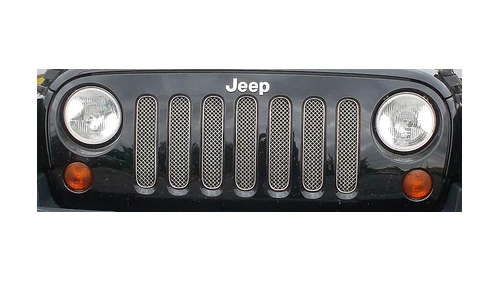
Photo: Fiver, der Hellseher, CC BY-SA 4.0, cropped. The mesh grille inserts are aftermarket.
On this Wrangler the seven slots sit between two round headlights, with the wordmark above them. This is the front that logo sites reduce to the flat seven-bar icon described above.
Hidden Symbols on a Jeep: The Easter Eggs
The hidden symbols on a Jeep are called Easter eggs, the term Jeep uses on its own Stellantis blog. They are small graphics that designers tuck into the lights, glass and bodywork for owners to find.
According to Jeep design head Mark Allen, Jeep Easter eggs started with the 2011 Grand Cherokee. Designers then spread them to other models. Examples:
- 2011 Grand Cherokee: tiny Jeep grilles inside the headlamp bulb shields.
- Wrangler: the profile of a Willys jeep climbing up the corner of the windshield.
- Other models: Morse-code messages, symbols hidden on the exterior, map coordinates and playful images under the hood.
Jeep Logo Font and Colors
Is the Jeep logo Helvetica? Not officially. The wordmark closely resembles Helvetica Bold, and some sources say Helvetica Black, but Jeep has never named its typeface. Earlier logos used other lettering, including the 1945 serif and, according to Logopedia, custom type in the early 1970s.
- Font: a bold Helvetica-style sans-serif. To write the Jeep logo in text, a bold Helvetica-style font gets close, but the Jeep name itself is a trademark.
- Colors: khaki or olive green, or black, since 1993. Earlier versions added red (1941, 1963 and 1970), gold, silver and cream (1963) and blue (1970). A black and white Jeep logo is simply the black wordmark.
Jeep Emblems and Badges on the Car
The main Jeep emblem on a modern vehicle is the wordmark itself; MotorTrend notes it sits on the hood of many current models. The second badge is the seven-slot grille on the front.
- Jeep badge on the hood: the bold sans-serif wordmark.
- Round Jeep emblem: the only round design in the logo history is the 1963–1970 Kaiser Jeep badge.
- Tiny graphics on the glass or lights: these are Easter eggs, not official badges.
Jeep Logo PNG: Free Download
Use the download button at the top of this page to get the Jeep logo PNG: the olive-green wordmark on a transparent background, good for presentations, clipart or print. The Jeep name is a trademark of the brand’s owner, Stellantis, so use the file to identify the brand or for editorial purposes only.
Frequently asked questions
Does Jeep stand for "Just Enough Essential Parts"?
No. "Just Enough Essential Parts" is a joke backronym, like "Just Empty Every Pocket." None of the documented theories about the name treats Jeep as an acronym, so the real answer to "What does Jeep stand for?" is nothing. Enjoy the joke, but do not repeat it as history.
Is Jeep Ford or Chrysler?
Neither today. Jeep has belonged to Stellantis since 2021. Before that it passed from Willys-Overland to Kaiser (1953), American Motors (1970 to 1987), Chrysler (1987), DaimlerChrysler (1998) and Fiat Chrysler Automobiles (2014). Ford built thousands of wartime jeeps as the GPW but never owned the brand.
Is Jeep German or American?
Jeep is American. It grew out of a 1940 US Army request for a light four-wheel-drive reconnaissance car and is headquartered in Toledo, Ohio, where Willys-Overland began building civilian jeeps in 1945. The German link is short: Jeep was part of DaimlerChrysler, formed by Chrysler's merger with Daimler-Benz, from 1998 to 2007.
Who actually designed the Jeep?
American Bantam did. Freelance designer Karl Probst drew the Bantam prototype in 1940, and in 1943 the Federal Trade Commission found that Bantam invented the jeep. Willys-Overland refined the design into the MB, which won the production contract, and Ford built it as the GPW. Toyota did not make the first Jeep.
Does the Jeep logo have a horse on it?
No. No version of the Jeep logo has ever shown a horse or any other animal. Jeep has used lettering alone, lettering with a red triangle and blue rectangle, a round badge and the Chrysler Pentastar. If you are thinking of a car badge with a horse, it belongs to another brand.
What is Jeep's slogan?
Jeep has used several slogans rather than one fixed line. "Jeep. There's Only One." was a 1990s slogan from the Chrysler years, not a current one. MotorTrend calls "Go Anywhere, Do Anything" the brand's most recent motto, and also lists 2000s lines such as "Legends aren't born, they're made."
Is the Jeep name trademarked?
Yes. Willys-Overland applied for the Jeep trademark in February 1943 and, after years of opposition from Bantam and Minneapolis-Moline, received it in June 1950. That registration was for the name; no source shows the logo lettering was registered with it. The seven-slot grille is also a protected trademark of the brand's owner.