Key facts
- Founded
- 1910
- Founded by
- Ugo Stella
- Country
-
 Italy
- Headquarters
- Turin, Italy
- Parent company
- Stellantis
- Legal name
- Alfa Romeo Automobiles S.p.A.
- Famous models
- Giulia, Stelvio, Tonale, Junior, 33 Stradale
- Website
- www.alfaromeo.com
Alfa Romeo Logo Meaning: What the Cross and the Snake Stand For
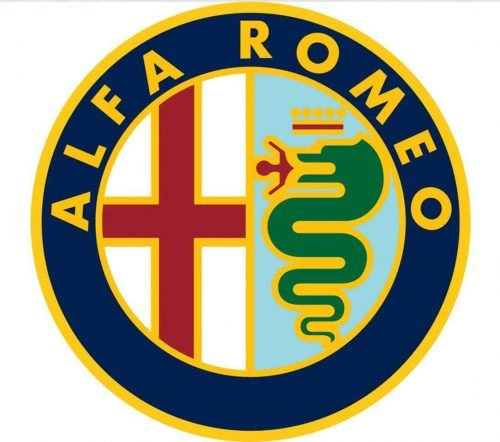
Both parts come from Milan, where the company started in 1910. The red cross on white is the emblem of the City of Milan. The Biscione is the crowned serpent of the Visconti family, who once ruled Milan. So the logo is local heraldry. Some parts are well documented; others rest on stories that disagree.
| Part of the badge | What it is | Status |
|---|---|---|
| Red cross on white | Emblem of the City of Milan | Documented; Crusades link is tradition |
| Biscione | Crowned serpent of the Visconti | Documented |
| Figure in the jaws | A human figure | Who it is: claimed, sources differ |
| Crown | Sits on the serpent’s head | Meaning: claimed, sources differ |
| Savoy knots, then wavy lines | Knots honoring the King of Italy, later wavy lines | Documented; swap date differs |
| Laurel wreath, 1925–1982 | Marks a 1925 championship win | Documented; color differs |
The Red Cross: Milan’s Civic Emblem
Alfa Romeo’s own badge history calls the red cross on white the cross of the municipality. Tradition links it to Milanese soldiers in the Crusades, and dealer sites tie it to St. Ambrose or St. George, but no source settles which.
The Biscione: Why the Logo Shows a Snake Eating a Man
The snake is the Biscione, roughly “big grass snake,” the heraldic serpent of the Visconti family. It wears a crown and holds a human figure in its mouth, which puts Alfa Romeo among the car logos with snakes and crowns.
Who that figure is remains open: some histories see a defeated Saracen or Moor, Wikipedia describes a child, and others read it as rebirth. “A snake eating a man” is one reading, not a settled fact. The crown is disputed too: MotorTrend says it set the city’s official Biscione apart from the family’s private one, while dealer sites link it to the Visconti dukedom of the 15th century.
Legends add more, none documented: a Visconti ancestor beating a Saracen with a man-eating serpent on his shield, or a bronze serpent brought from Constantinople around the year 1000.
Is the Alfa Romeo Logo Religious?
No source presents it as a religious emblem. Both symbols entered the badge in 1910 as heraldry of Milan. The cross stands for the city, and its Christian association comes only from the crusader tradition. The Biscione is the coat of arms of a ruling family, not a sacred image.
Alfa Romeo Logo History and Evolution
The badge has had nine versions since 1910. The cross and the snake appear in every one, while the lettering, frame and colors changed. The background split into white and light-blue halves lasted until 2015, so it is the quickest way to tell the old and new logo apart.
1910: The Original Alfa Romeo Logo
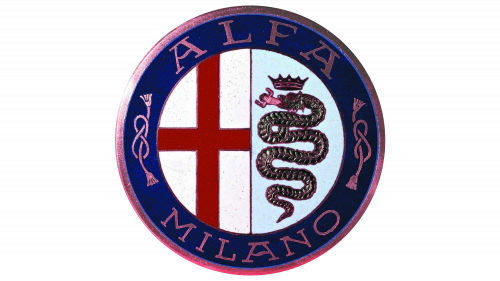
In June 1910 the board asked chief engineer Giuseppe Merosi for a badge for the first car, the 24 HP. Romano Cattaneo, a young draftsman in the technical office, drew it with him after seeing the Biscione on Castello Sforzesco while he waited for the number 14 tram in Piazza Castello. Managing director Ugo Stella approved it.
The tell: a 65 mm enameled brass disc with ALFA at the top, MILANO at the bottom and two figure-eight Savoy knots between them, a tribute to the King of Italy. The brass lettering turned to white enamel in 1913.
Around 1918: ALFA-ROMEO Replaces ALFA
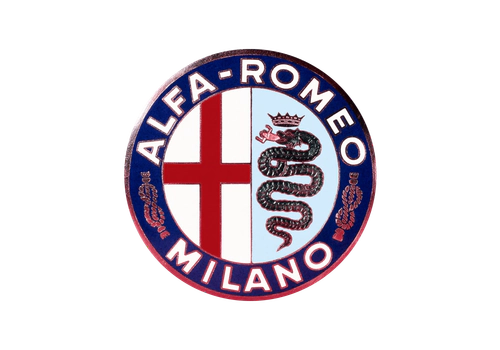
Nicola Romeo took control of the company in August 1915, and his name later moved onto the badge. Sources disagree on when: Alfa Romeo’s own badge page says 1915, Wikipedia and MotorTrend say 1918. The first car to carry the new name came in about 1920–21: Wikipedia names the 1920 Torpedo 20-30 HP, and the Alfa Romeo museum the 20-30 ES of 1921.
The tell: the ring reads ALFA-ROMEO with a hyphen, while MILANO, the knots and the split disc stay.
1925: The Laurel Wreath
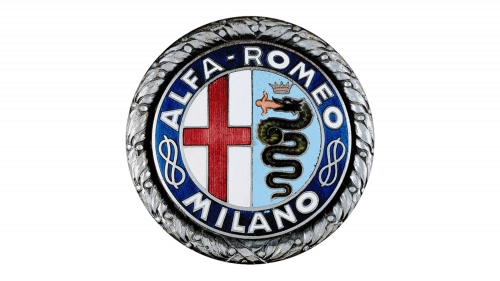
In 1925 the Alfa Romeo P2, designed by Vittorio Jano, won the first World Manufacturers’ Championship, and a laurel wreath went around the badge to mark it. Wikipedia calls the wreath silver; Alfa Romeo’s own text says golden.
The tell: a metal wreath circles the blue ring, with the lettering and knots kept inside. In varying forms, the wreath stayed until 1982.
1946: The Red Post-War Badge
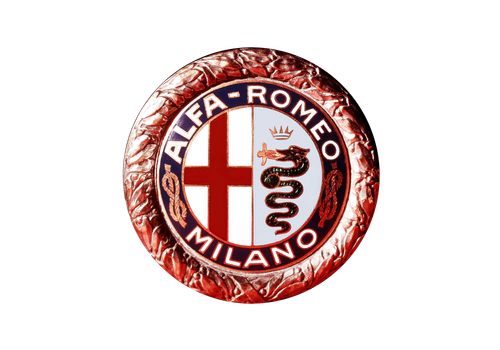
After World War II the Alfa Romeo badge turned red. The company says the war destroyed the machines that made the multicolor badges. Wikipedia ties the redesign to the end of the monarchy, when the Savoy knots gave way to two wavy lines.
The tell: no blue or white enamel, just a red field with metallic lettering, cross and serpent, described as antique silver or gold-toned. Wikipedia says it was stamped steel, 54 mm across. It lasted until 1950.
1950: Full Color Returns
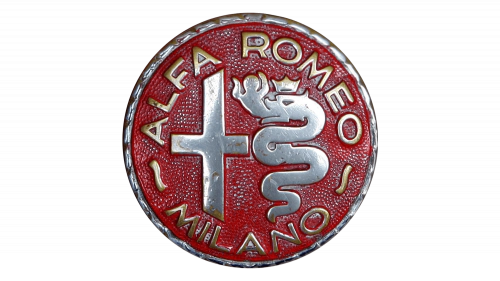
In 1950 the enameled, full-color badge came back, with MILANO and the two wavy lines kept. Alfa Romeo’s own badge page dates the knots-to-wavy-lines swap to 1950, not 1946.
The tell: the blue ring, white cross field and light-blue serpent field of 1910, wavy lines in place of the knots, and a thin rope-like metal border.
1960: Smoother Lines and Plastic
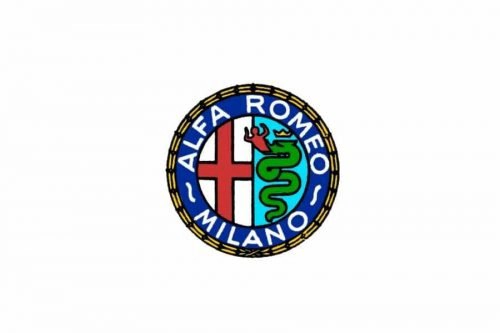
In 1960 the badge changed from brass to plastic. MotorTrend dates a smoother drawing to the same period, with gold outlines around the letters, the cross and the serpent.
The tell: the 1950 layout, MILANO included, but the serpent has no scale texture, the figure has no muscle detail and the ring is a flat blue.
1972: Milano Is Dropped
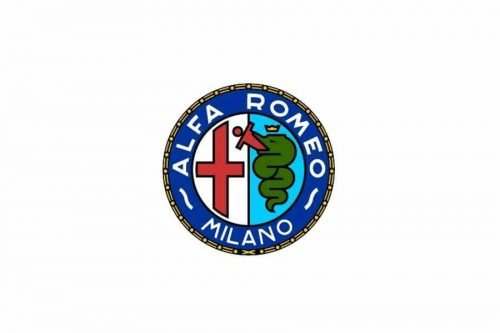
In 1972 the word MILANO left the badge, along with the wavy lines. The change is tied to the Alfasud, built at a new factory in Pomigliano d’Arco, near Naples, which that year became the first Alfa Romeo passenger car made outside Milan. The serpent and lettering were modernized, reportedly by designer Pino Tovaglia.
The tell: ALFA ROMEO along the top, and plain blue at the bottom of the ring.
1982: The Wreath Goes
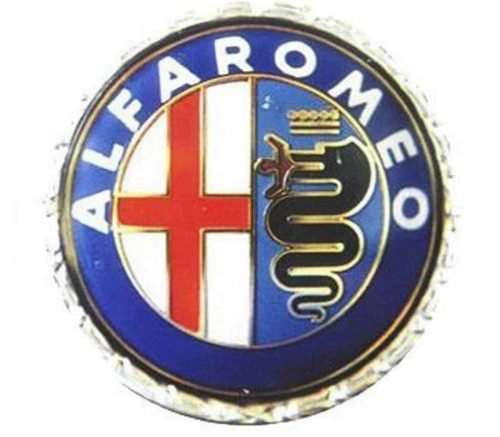
The 1982 Alfa Romeo badge dropped the last of the wreath and grew larger. The lettering and outlines turned gold, the serpent was simplified, and the name was reset in Futura-style letters. No other version lasted as long: it stayed until 2015.
The tell: no wreath, gold edges, and the two halves still split by a bar. Glossy gradient images from the 2000s show this same badge, not a separate redesign.
2015: The Current Alfa Romeo Logo
The new Alfa Romeo logo was unveiled on June 24, 2015, the company’s 105th anniversary, at the Alfa Romeo Museum in Arese, together with the new Giulia. Milan agency Robilant Associati, which also reworked the Fiat and Lancia logos, designed it.
The tell: one silver textured background, which Alfa Romeo calls pyramidal, replaces the two halves, and with the dividing bar gone the cross and serpent touch. The colors drop from four to three, and the new serif letters are silver instead of gold.
Alfa Romeo Logo Colors, Font and PNG Download
The current logo uses three colors on a silver base:
- Green for the serpent
- Red for the cross
- Dark blue for the outer ring
- Silver for the background, edges and lettering
The 1982–2015 lettering was Futura-style; the 2015 badge has a new serif typeface.
Need the Alfa logo for an article or a presentation? The button at the top of this page downloads the Alfa Romeo logo PNG in the 2015 design.
Alfa Romeo Quadrifoglio: The Other Alfa Badge
The four-leaf clover is not the Alfa Romeo logo but a second badge, the Quadrifoglio. Ugo Sivocci painted a green clover on a white square on his Alfa Romeo RL for the 1923 Targa Florio and won; the square later became a triangle in his memory.
The clover, green or gold, has been Alfa’s racing symbol since. The first road car to wear it was the 1963 Giulia TI Super, and Quadrifoglio versions of the Giulia and Stelvio are in today’s range.
What Alfa Romeo Means: Where the Name Comes From
ALFA stands for Anonima Lombarda Fabbrica Automobili, roughly “Lombard Automobile Factory Corporation,” the company’s name at its founding in 1910. So Alfa is an acronym, not the Greek letter alpha.
Romeo is a surname: Nicola Romeo, a Neapolitan entrepreneur and engineer, ran the company from 1915 to 1928 and gave it his name. The company was never called “Alfa Milano”; MILANO was only a word on the badge.
Frequently asked questions
Is it Alfa Romeo or Alpha Romeo?
The correct spelling is Alfa Romeo, with an f. "Alpha Romeo" is a common misspelling. The company name, the lettering on every version of the badge since 1910 and the official website, alfaromeo.com, all use Alfa.
Who founded Alfa Romeo?
Cavaliere Ugo Stella, a Milan aristocrat, set up A.L.F.A. on June 24, 1910, with Italian co-investors. They took over the Portello plant from Darracq's failing Italian subsidiary, SAID, so Alexandre Darracq was not a founder. The first car, the 24 HP, was designed by Giuseppe Merosi. Nicola Romeo took control in 1915.