Key facts
- Founded
- 1925
- Founded by
- Walter P. Chrysler
- Country
-
 United States
- Headquarters
- Auburn Hills, Michigan, United States
- Parent company
- Stellantis
- Famous models
- Pacifica, Voyager
- Website
- www.chrysler.com
New Chrysler Logo 2026: The Redesigned Winged Badge
On April 1, 2026, Chrysler unveiled a redesigned wing badge on the refreshed 2027 Pacifica at the New York International Auto Show, replacing the winged badge it had used since 2010.
The symbol is still a pair of wings; the new badge redraws them and adds a new wordmark.
What the 2026 Chrysler Logo Looks Like
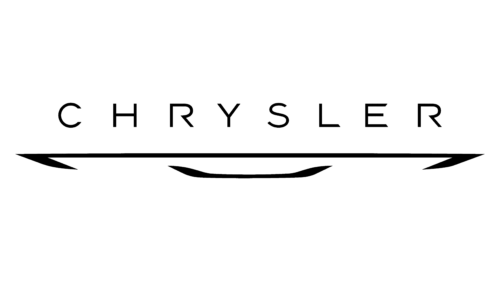
What does the badge look like now? An extended, squarish CHRYSLER wordmark sits above thin, flat wings that dip in the middle, with no nameplate between them. Chrysler describes the badge as having “a cleaner, more digital aesthetic,” with lettering created in-house. On the 2027 Pacifica the badge lights up.
The wings remain the core of the logo. What is gone is the blue nameplate that sat between the chrome wings of the 2010 badge.
Some logo sites date a flat black wings redesign to 2023. That change never happened: the 2010 badge stayed in use until April 2026.
From Concept Cars to Production: 2022, 2024 and 2026
The new wings took four years to reach a production car. Chrysler previewed them on the Airflow concept in 2022, refined them on the Halcyon concept in 2024, and put them on the Pacifica in April 2026.
Logopedia dates the concept version’s first public use to February 6, 2024, when it appeared on social media with the Airflow Graphite concept. Chrysler’s website now calls the design a “newly redesigned winged logo” and puts it on brand merchandise.
Chrysler Logo Meaning: What the Wings and Symbol Stand For
The Chrysler logo stands for speed and quality. The wings go back to the winged radiator cap on early Chrysler cars, which Chrysler says was inspired by the Roman god Mercury and stood for speed and freedom. The first emblem, a “ribbon seal,” was made to look like a prestigious award, signaling quality and engineering excellence.
What has appeared in the logo over the years:
- Wings: on radiator caps and badges from the 1920s to the mid-1950s, then absent for decades, and back on the badge by the late 1990s.
- The seal: a gold disc with a scalloped edge, a diagonal CHRYSLER banner and a blue ribbon tab.
- The Pentastar: five blue triangles around a white star, with no text, so it read the same in any language.
- Blue and silver: the colors of the 2010 badge, commonly read as professionalism and stability. That reading comes from logo sites, not from Chrysler.
Two claims need a correction. A popular story ties the Pentastar’s five points to five divisions, but Chrysler never confirmed it, and DeSoto had already ended in 1961. Many histories also credit Chrysler engineer Oliver Clark with the early seal and the winged radiator ornament, though Chrysler itself names no designer.
Chrysler Logo History: Every Old Chrysler Logo From 1924 to Today
The logo follows one main thread: a seal, then wings, then the Pentastar, then wings again, with a few detours. This history covers the brand badge, so everything below appeared on Chrysler cars. Corporate marks such as the DaimlerChrysler, Chrysler Group, FCA and Stellantis logos are left out. Where sources give different years, both are noted.
1920s: The Winged Radiator Cap
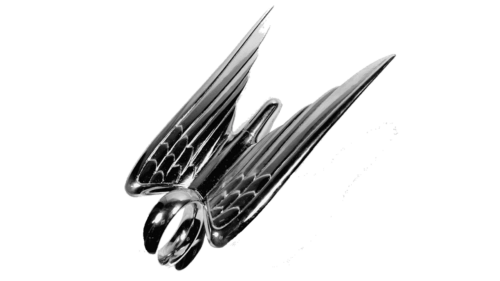
Early Chryslers carried a chrome winged ornament that Chrysler says was inspired by Mercury. Sources disagree on the year it first appeared, so “the 1920s” is the safe date.
1924–c.1930: The Ribbon Seal
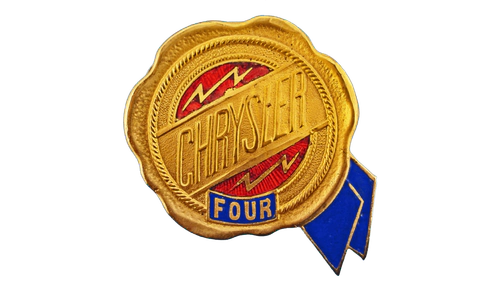
The original Chrysler logo is the 1924 ribbon seal: a round gold seal with a scalloped edge, a diagonal CHRYSLER banner and a blue ribbon tab at the lower right. The seal is older than the company: the first Chrysler car went on sale under Maxwell in January 1924, a year before Chrysler Corporation was formed.
1930s–1950s: The Seal on Silver Wings
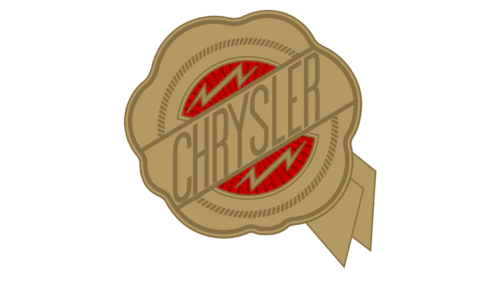
By the 1930s the seal was flanked by silver striped wings, a look that lasted until the mid-1950s. The seal turned burgundy and gold, and the blue ribbon at its center dates from this decade. Sources put the arrival of the wings at 1930 or 1936.
What changed: the seal gained a pair of wings.
1950–1952: The Lion and Bird Ornaments
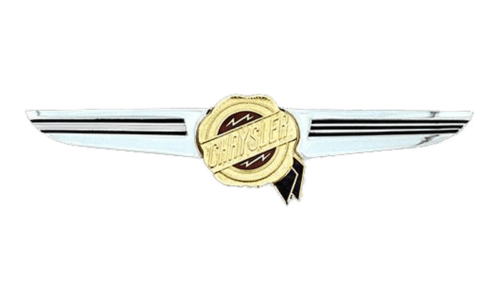
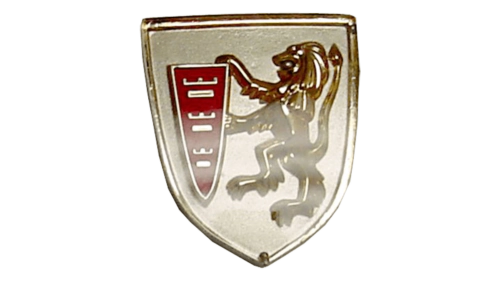
Some logo histories list a 1950 lion shield and a 1951–1955 bird as Chrysler logos. The bird was a chrome hood ornament on 1951–52 New Yorker and Imperial models, not a brand badge. The lion shield has no solid source and may belong to another make.
1955–1962: The Forward Look Boomerangs
For 1955 the wings gave way to two overlapping boomerangs pointing right, a long black one over a wider red one. It was the mark of the Forward Look styling program led by Virgil Exner, shared across Chrysler Corporation, including Dodge. Despite a common claim, it was not a reference to the Hemi V8.
1962–c.1993: The Pentastar
In 1962 the Pentastar took over: five blue triangles forming a pentagon, with a white star in the gaps and the CHRYSLER name below. It was the corporate mark of Chrysler Corporation until 1998, and it also served as the badge on Chrysler cars into the mid-1990s. The full Pentastar story is below.
1980s: The Wordmark

Through the 1980s the Pentastar was often paired with an all-caps CHRYSLER wordmark in a wide, squared typeface with open R’s. Sources disagree on the years: Logopedia runs a custom wordmark from 1963 to 1993. No wings or seal appear in this period.
Mid-1990s: The Seal Returns
In the mid-1990s the ribbon seal came back, at first without long wings. Logopedia dates its return to 1993. Wikipedia says the revived brand emblem replaced the Pentastar on the LHS sedan in 1995.
1998–2010: Seal Between Silver Wings
The 1998 badge put a black-and-gold roundel between two long, thin silver wings, with a bold CHRYSLER wordmark above. Logopedia credits the design firm Lippincott & Margulies and dates the work to 1997. With this version, long wings returned to the Chrysler badge.
2010–2026: Wings With a Blue Nameplate
The 2010 badge dropped the seal, the ribbon and the Pentastar. Layered chrome wings with a metallic gradient flank a dark blue nameplate with silver CHRYSLER lettering. It was unveiled in January 2010 and used on cars from the 2011 model year, though some sites date it to 2009, when the design leaked. It remained the Chrysler logo until April 2026.
2022–2024: The Concept-Car Wings
The Airflow (2022) and Halcyon (2024) concepts previewed a new look: thin, flat wings drawn as tapering lines with a small dip in the middle, a widely spaced CHRYSLER wordmark above, and no blue nameplate. The 2026 production badge is a refined version of these wings.
2026: Today’s Winged Logo
The current Chrysler logo is the redesigned wing badge introduced on the 2027 Pacifica in April 2026, and it is the main logo shown at the top of this page. See how it was described in the first section.
The Chrysler Pentastar: Meaning, Designer and Why It Was Dropped
The Pentastar is a pentagon of five blue triangles whose gaps form a white five-pointed star, introduced in 1962. It was the symbol of Chrysler Corporation as a whole, not only of Chrysler cars.
That explains most of the confusion. The Pentastar stayed the corporate logo until 1998, while the Chrysler car badge went back to the ribbon seal in the mid-1990s.
Who Designed the Pentastar and What It Means
Robert Stanley, an account executive at the design firm Lippincott & Margulies, designed the Pentastar, picked from about 800 proposals; Stanley also specified the blue. Chrysler president Lynn Townsend reportedly wanted one mark that every division could use worldwide, and because the Pentastar carried no text, it worked in any language. The triangles are deliberately left unjoined to give the mark an engineered look.
The five points have no confirmed meaning. The five-divisions story fails on dates: by September 1962 only four passenger makes remained, Plymouth, Dodge, Chrysler and Imperial, because DeSoto was discontinued in 1961.
Where the Pentastar Was Used and When It Ended
The Pentastar left the cars and the company at different times. Into the 1990s it still sat in the grille of the Chrysler Concorde. On the LHS it gave way to the revived Chrysler brand emblem in 1995.
As the corporate logo, it was retired at the 1998 merger with Daimler-Benz, which created DaimlerChrysler. The marks that followed, Chrysler Group (2007–2014), FCA (2014–2021) and Stellantis (since 2021), are company logos, not Chrysler car badges.
Chrysler Logo vs Bentley, Aston Martin and Genesis: Why the Wings Look Alike
Chrysler, Bentley, Aston Martin and Genesis all use a pair of wings split by a central element, and the center is the quickest way to tell them apart. Bentley puts a B there, Aston Martin its name in a rectangle, Genesis its name in a shield, and Chrysler’s 2010 badge its name on a blue nameplate.
Winged emblems are common among car brands, so a resemblance says nothing about shared ownership.
| Badge | Center | Wings | Text on the badge | Wings since | Owner today |
|---|---|---|---|---|---|
| Chrysler (2010–2026) | Dark blue nameplate | Layered chrome wings with a metallic gradient | CHRYSLER | 1920s radiator cap; seal with wings by the 1930s | Stellantis |
| Chrysler (1998–2010) | Black-and-gold roundel | Long, thin silver wings | CHRYSLER above the badge | Same | Stellantis |
| Bentley | B in an oval; a B jewel since 2025 | Feathered (10 left, 11 right on the 2002 badge) | B | 1919 | Volkswagen Group |
| Aston Martin | Name in a rectangle | Feathered since 1932 | ASTON MARTIN | 1927 | Aston Martin Lagonda (listed company) |
| Genesis | Black shield | Pair of wings | Genesis | Brand launched in 2015 | Hyundai |
The 2026 Chrysler badge is left out because Chrysler’s release does not detail its center. For more examples, see our list of car logos with wings.
Chrysler vs Bentley Logo
Telling the Chrysler logo from the Bentley logo comes down to the letter: Bentley’s Winged B has a B at the center, while Chrysler’s badges carry the CHRYSLER name or, before 2010, a seal.
Bentley’s wings are also older and feathered. F. Gordon Crosby drew the first Winged B in 1919, the 2002 version has 10 feathers on the left and 11 on the right, and Bentley redrew the wings in July 2025.
Aston Martin vs Chrysler Logo
Aston Martin writes its full name across the middle of its wings, inside a rectangle; Chrysler put its name above the badge (1998–2010) or on a nameplate (2010–2026).
Aston’s wings first appeared in 1927. In 1932 racing driver Sammy Davis gave them feathers, inspired by the Egyptian scarab, and in 2022 they were redrawn with designer Peter Saville. The two are easiest to confuse on the 1998–2010 Chrysler badge with its long silver wings; look at the middle, where Aston Martin has a rectangle, not a roundel.
Genesis vs Chrysler Logo
The Genesis emblem splits two wings with a black shield reading “Genesis,” where Chrysler’s older badges used a nameplate or a seal. Genesis became a separate Hyundai brand on November 4, 2015, so its wings are the newest of the four.
Media often note that the Genesis badge looks like Bentley’s, but no Genesis statement on the design’s origin has been found, so “similar” is the fair word, not “copied.”
Chrysler Emblem and Badge on the Car: Where It Sits and PNG Use
The badge on a new car today is the illuminated wing badge on the 2027 Pacifica. For model year 2026 Chrysler sells only two minivans, the Pacifica and the Voyager, and the 300 sedan ended production in December 2023. Most Chrysler badges on the road are therefore older ones: the 2010 wings, used from the 2011 model year, or the seal between silver wings on earlier cars.
Where the badge sits has changed too. Enthusiast histories describe the Pentastar of the 1960s on fender badges and keys, and a gem-like Pentastar hood ornament in the 1980s.
The main logo at the top of this page is the 2026 version: an extended, squarish CHRYSLER wordmark above thin wings. The button under it downloads that Chrysler logo as a PNG.
Frequently asked questions
Why did Chrysler change its logo?
There was no single reason; each change followed a turn in the company's history. The boomerangs arrived with the 1955 Forward Look styling overhaul, the Pentastar gave the corporation one text-free mark in 1962, the mid-1990s brought back the original ribbon seal, and the 2026 badge was redrawn for "a cleaner, more digital aesthetic."
Is Chrysler related to Bentley or Genesis?
No. Chrysler belongs to Stellantis, Bentley has been part of Volkswagen Group since 1998, and Genesis was set up by Hyundai as a separate brand. The only link is a winged badge, and winged emblems are common among carmakers. One personal tie exists between Genesis and Bentley: Genesis design chief Luc Donckerwolke was once Bentley's design director.
Is Chrysler named after a real person?
Yes. Chrysler is named after its founder, Walter P. Chrysler, who formed Chrysler Corporation in June 1925 by reorganizing the Maxwell Motor Company. His name went on a car a year earlier: the Chrysler Six of January 1924, priced at $1,565 and fitted with four-wheel hydraulic brakes as standard.