Key facts
- Founded
- 1935
- Founded by
- Kenzo Adachi
- Country
- Japan
- Headquarters
- Ageo, Saitama, Japan
- Parent company
- Isuzu
- Legal name
- UD Trucks Corporation
- Famous models
- Quon, Condor, Croner, Quester
- Slogan
- “Ultimate Dependability”
- Website
- www.udtrucks.com
Brand History and Ownership Changes
UD Trucks was founded on December 1 1935 by Kenzo Adachi in Kawaguchi near Tokyo under the original name Nihon Diesel Industries Ltd. The company experienced multiple name changes in its early decades including Kanega-Fuchi Diesel Co Ltd in 1942 Minsei Industries Ltd in 1946 and Minsei Diesel Industries Ltd in 1950.
In 1955 the firm introduced the Uniflow Diesel two-stroke engine which created the UD name originally standing for Uniflow Diesel. The brand now interprets these letters as Ultimate Dependability.
Ownership evolved significantly over time. The company was acquired by Nissan Motor Co in 1960 and renamed Nissan Diesel Motor Co Ltd. It operated under Nissan Diesel until 2010. Volvo Group acquired the business in 2007 and in 2010 the company was renamed from Nissan Diesel to UD Trucks. Isuzu Motors became the owner in 2021 and remains the current parent company. The manufacturer has focused exclusively on diesel trucks and buses throughout its history.
UD Trucks Logo Evolution
1935–1999: First Logo Era
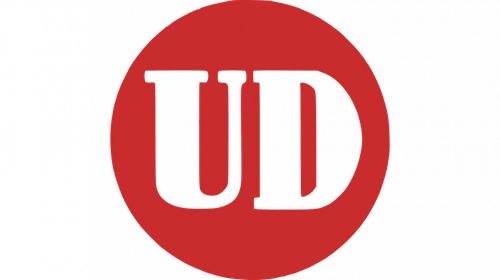
The original UD emblem remained in use for more than six decades from the company’s founding. This design established the visual identity that would define the brand for generations of truck and bus drivers.
- Design featured a circular medallion shape
- Colors consisted of a solid bright red background with bold white lettering
- Typography used an elegant serif typeface for the UD letters
- Context involved placement on vehicle bonnets and grilles
1999–2010: Second Logo Era
A major redesign occurred in 1999 during the later years of the Nissan Diesel period creating a distinct new visual identity. This UD Trucks logo evolution moved away from the long-standing circular form to a more contemporary appearance.
- Design adopted an ellipsoidal oval medallion
- Colors used a dark blue background with gradient shades and thick silver outline
- Typography featured custom sans-serif UD lettering where letters shared a vertical bar
- Context reflected stability and a serious approach to business
2010–Present: Third Logo Era
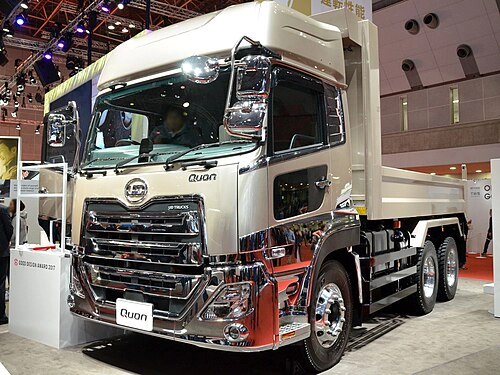
The current UD symbol was introduced in 2010 alongside the official company rename from Nissan Diesel to UD Trucks. This redesign coincided with renewed emphasis on the Ultimate Dependability brand meaning.
- Design presents a hybrid shape between circle and oval
- Colors include a solid red background with gradient silver framing and black outline
- Typography employs a smooth bold sans-serif typeface often paired with UD TRUCKS logotype below
- Context marks the transition to the modern UD Trucks identity
Connection Between Corporate Milestones and Visual Identity
Several key events in the company’s timeline directly influenced its visual branding. The 1935 founding immediately introduced the first red circular UD Trucks logo. The 1955 creation of the UD name and Uniflow Diesel engine built upon the already established emblem.
The 1999 logo redesign to the blue oval occurred without a major ownership change. The 2007 acquisition by Volvo Group did not trigger an immediate logo update. However the 2010 name change to UD Trucks launched the third and current UD Trucks emblem. The 2021 acquisition by Isuzu has not altered the 2010 design which remains in use today.
This timeline shows how the UD Trucks logo history reflects both internal engineering achievements and external corporate ownership transitions while maintaining a consistent focus on dependability in commercial vehicles. The brand’s visual evolution provides a clear record of its journey from a small Japanese diesel manufacturer to a global trucks and buses producer.