Key facts
- Founded
- 1955
- Country
- Japan
- Headquarters
- Toyota City, Aichi, Japan
- Parent company
- Toyota Motor Corporation
- Famous models
- Crown Sedan, Crown Crossover, Crown Sport, Crown Estate, Crown Signia
- Slogan
- “itsuka wa Crown”
- Website
- toyota.jp/crown
Toyota Crown Brand Overview
If you have seen a car with a crown logo on its grille or hood, it is almost certainly a Toyota Crown. The Toyota Crown logo is a model-specific insignia: on Japanese-market cars it takes the place of the usual Toyota ellipses, which is why the car can look like it comes from a separate luxury brand.
The Crown went into production on 1 January 1955 as the Toyopet Crown, Toyota’s first mass-production car built entirely with its own technology, and it was designed under Kenya Nakamura. It became a favourite of Japanese taxi fleets, executives and the police. It was also Toyota’s first export to the United States, where 30 Crown Deluxes arrived in June 1958. American sales ended in 1972.
After fifteen generations of mostly conservative sedans, Toyota revealed a 16th generation on 15 July 2022 in four body styles: Crossover (on sale September 2022), Sport and Sedan (late 2023) and Estate (March 2025). It is sold in about 40 countries, and it brought the Crown back to North America as a 2023 model, later joined by the Crown Signia, the Estate’s North American version.
Toyota Crown Logo Meaning
“Crown” means exactly what it says, and Toyota built a family of royal names around it: Corona (1957) and Corolla (1966) come from the Latin words for “crown” and “small crown”, and Camry comes from kanmuri, the Japanese word for crown. The emblem turns the name into a picture: in almost every version, three arches stand on one or two bars under a small jewel or cross.
The badge also carries status. The 1983 slogan itsuka wa Crown (“someday, a Crown”) turned the car into a symbol of success in Japan.
Toyota Crown Logo Evolution
The Toyota Crown insignia has usually changed with a new generation. The images are cropped from photographs of real cars, plus one dealer display.
1955–1962: The Original Toyopet Crown
The first-generation car used the most literal crown of all: a rounded royal crown with four arches, gold outlines and wine-red fill. Early cars did not wear it as the main grille badge, though: surviving 1955 examples have a small shield in the grille, and the grille-mounted crown arrived with the next generation.
- Design: Rounded, realistic crown with four arches
- Colors: Gold and wine red
- Changes: The only Crown emblem with four arches
- Context: Launch of Toyota’s first home-grown passenger car
1962–1983: The Framed Crown Badge
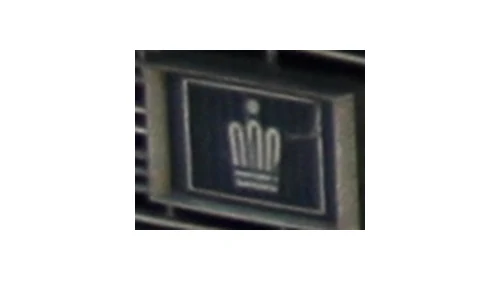
The second-generation Crown (S40) introduced the simplified symbol that is still recognisable today: three loops on two flat bars. It sat inside a frame shaped like a plaque or pennant, and it appeared on the grille and hubcaps. From the fourth generation (1971), a second crown badge was mounted on the rear roof pillar, and it remained a Crown trademark until 2018.
- Design: Three-arch crown on two bars, inside a rectangular or pennant-shaped frame
- Colors: A gold or silver crown on a dark field; the 1979 sixth generation used a blue-purple background
- Changes: Four arches reduced to three, plus a surrounding frame
- Context: The Crown grows from a taxi into Japan’s executive sedan
1983–2003: The Free-Standing Gold Crown
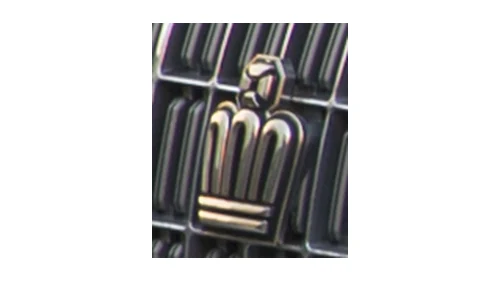
With the seventh generation in 1983, the frame disappeared and the crown stood alone on the grille, looking bigger and bolder. It changed only slightly through the eleventh generation.
- Design: Three fan-shaped arches over twin bars, with a jewel on top
- Colors: Gold on most models
- Changes: Frame removed, crown mounted directly on the grille
- Context: The “someday, a Crown” years and peak Crown sales around 1990
2003–2008: The Zero Crown’s Faceted Emblem
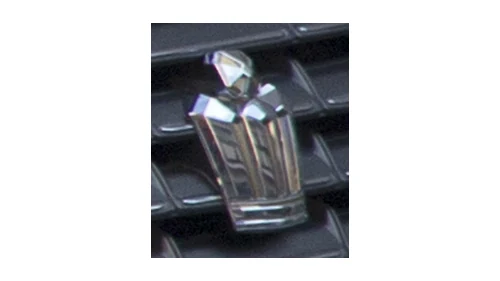
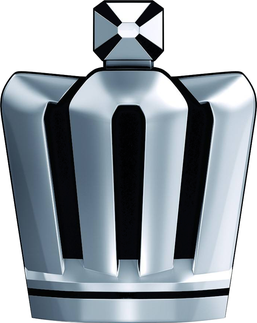
The twelfth generation, marketed as the “Zero Crown”, was aimed at younger buyers, and the flat outline became a sculpted, three-dimensional crown with pointed tips and silver edges.
- Design: Faceted, 3D crown with sharp peaks
- Colors: Chrome and silver
- Changes: Flat line art replaced by a solid, jewel-like form
- Context: New platform and V6 engines
2008–2018: Flat Panels and Hybrid Blue
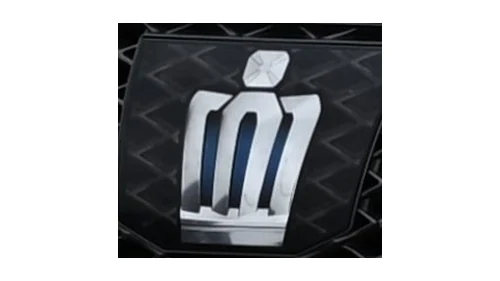
From the thirteenth generation (2008), the crown became a flatter, taller silver shape on a panel, because the emblem now also covered the radar for adaptive cruise control and pre-collision braking. The fourteenth generation (2012) gave hybrid badges a “Synergy Blue” background, and its huge grille was shaped to echo a crown.
- Design: Crown printed or moulded onto a flat panel
- Colors: Silver; blue background on hybrids
- Changes: Emblem becomes a sensor cover
- Context: The first Crown Hybrid arrived in 2008
2018–2022: The Sharpened Crown
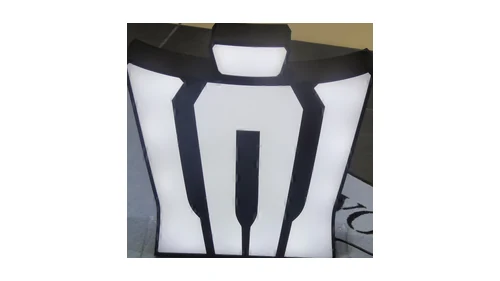
The fifteenth generation brought a more aggressive crown with pointed outer arches, more graphic than ornamental. The rear-pillar crown was no longer standard. In China, the same emblem also went on the Crown Kluger SUV and Crown Vellfire minivan.
- Design: Angular crown with pointed outer peaks and a squared jewel
- Colors: Chrome on the car, with blue inserts on hybrids; shown here as a white dealer light box
- Changes: Sharper, more abstract geometry
- Context: The last generation offered only as a sedan
2022–Present: A Lighter Crown for Four Body Styles
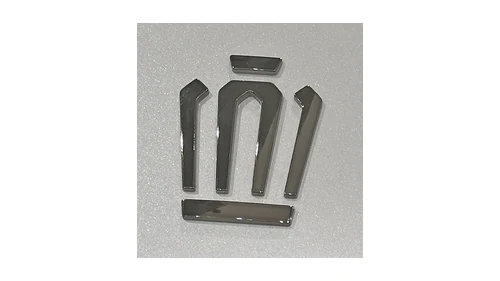
For the 16th generation, the crown was redrawn as five separate thin strokes: a top bar, three open arches and a base. It also moved from the grille to the leading edge of the hood. On Japanese cars the same symbol appears on the wheel centre caps and the steering wheel.
- Design: Open, line-drawn crown split into separate pieces
- Colors: Metallic chrome finishes (dark smoked chrome on the Estate shown)
- Changes: Lighter, flatter drawing; moved from the grille to the hood
- Context: One crown badge shared by the Crossover, Sport, Sedan and Estate
What Car Has a Crown Logo?
In most cases, it is the Toyota Crown. Japanese-market Crowns and the Chinese Crown Sport Cross wear the crown instead of the Toyota logo, and so did China’s Crown Kluger and Crown Vellfire.
North America is the exception: American Crowns have the regular Toyota emblem on the nose, wheels and steering wheel. Toyota says the Crown Signia’s name comes from the word “insignia”.
Other brands have a crown hidden inside a larger emblem, which is where people sometimes go wrong:
- Saab: the blue roundel shows a red griffin’s head wearing a crown, taken from the coat of arms of the Swedish province of Scania.
- Alfa Romeo: the Visconti serpent on the right half of the badge wears a crown.
In both, the crown is a small detail. A badge that is only a crown is a Toyota Crown.
FAQ
What kind of car has a crown emblem?
A car whose whole badge is a crown is a Toyota Crown, Toyota’s upscale model sold since 1955. On Japanese-market cars the crown replaces the Toyota logo on the front, wheels and steering wheel.
Why does the Toyota Crown not use the Toyota logo?
In Japan, some Toyota models carry their own badges, and the crown has marked Toyota’s upscale sedan since the 1960s. North American versions use the standard Toyota emblem instead.
Is the Toyota Crown an expensive car?
It sits at the upper end of Toyota’s range, and in Japan it has long been used as an executive and government car. In the US, the 2025 Crown Signia started at $43,590 before delivery fees.
Is the Toyota Crown still made?
Yes. The 16th generation launched in 2022 as four models (Crossover, Sport, Sedan and Estate), and in North America it is sold as the Crown and the Crown Signia.