Key facts
- Years active
- 1896–1941
- Founded by
- Johann Baptist Winklhofer, Richard Adolf Jaenicke
- Country
-
 Germany
- Headquarters
- Chemnitz, Germany
- Parent company
- Auto Union
- Legal name
- Wanderer-Werke AG
- Famous models
- W25K, W50, Typ 10, W24
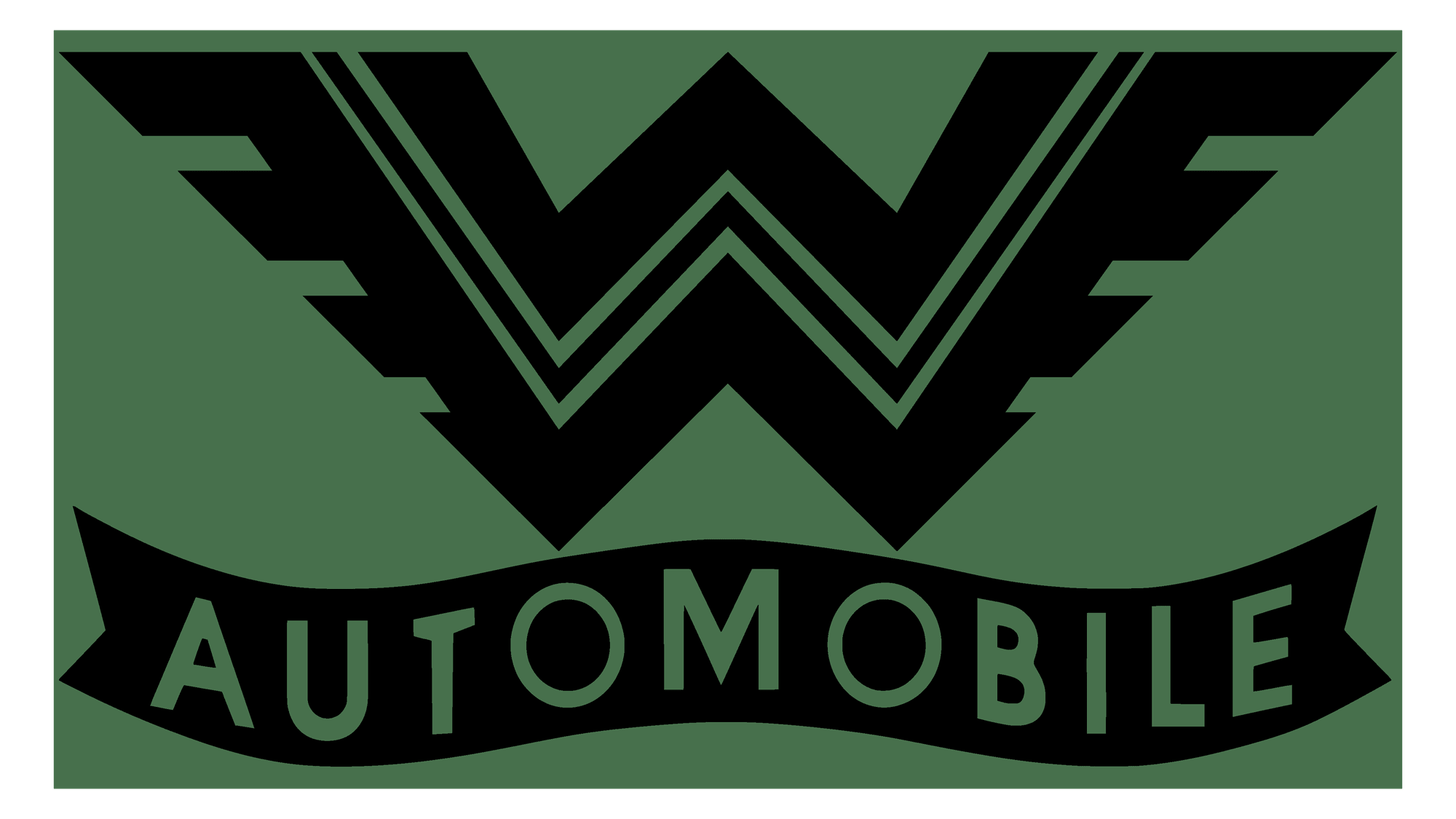
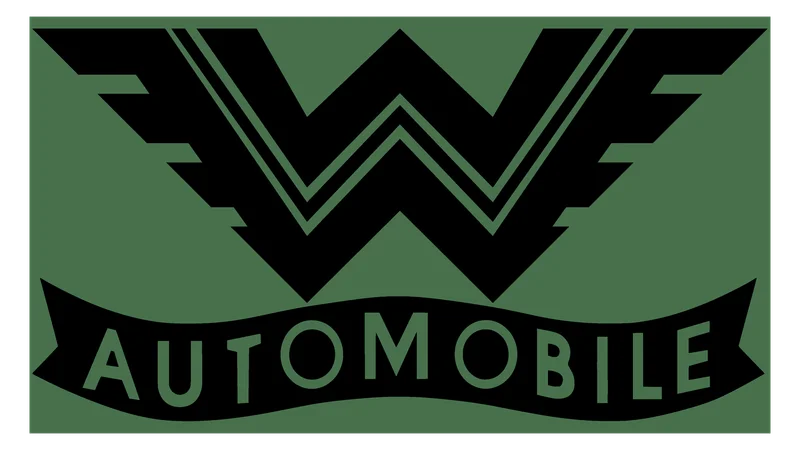
The Wanderer logo is a black winged W, with sharp stepped wings spreading out on both sides, above the word AUTOMOBILE on a green field. Wanderer was a German maker of bicycles, motorcycles and cars from Chemnitz, and in 1932 its car division became one of the four brands of Auto Union.
Wanderer Logo
The Wanderer emblem is built around a W whose two strokes rise into stepped, angular wings. In the version on this page the W is black and sits on a dark green background, and a curved banner with the word AUTOMOBILE in light capitals runs along the bottom. This Wanderer symbol is a design of letters only.
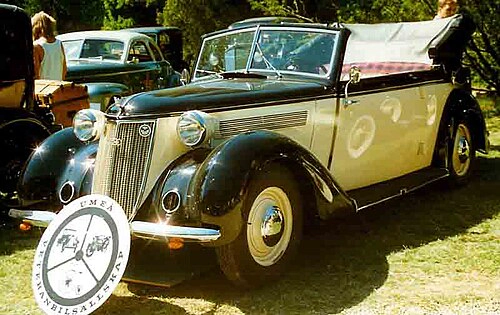
The same winged W was cast in metal as a radiator ornament: on a W26 the Wanderer badge is a chrome W standing above the grille. As a Wanderer car logo it marked the front of the car. This page offers the Wanderer logo PNG with a transparent background.
Wanderer Logo History
The Wanderer logo evolution runs through five versions, from a hand-written script to the winged W. The old Wanderer logo is a pure wordmark, and the later versions add a monogram.
Around 1896 to 1911 the name was written in a flowing gold script, with a long swash under the letters.
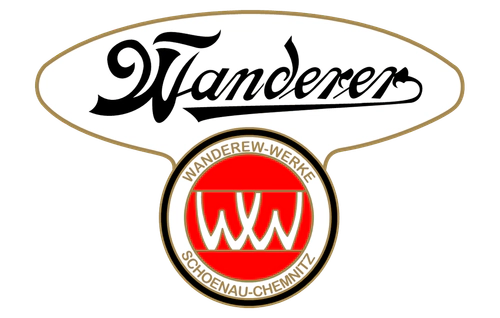
Around 1911 the script moved above a round red badge. The badge holds a white double W monogram inside a ring of text.

Around 1920 the monogram became a bold black W with angular wings, over the name WANDERER in plain capitals. This is the first version of the winged W, and it lasted until the early 1930s.
Around 1928 a separate badge appeared: a shield with a green and white chequered pattern, a silver outline and the name WANDERER on a banner.
Around 1930 the winged W returned in black and the plain name was replaced by an arched banner reading AUTOMOBILE. This new Wanderer logo is the one shown at the top of the page. After the 1932 merger the winged W was shown next to the Audi, DKW and Horch emblems in the Auto Union group’s history.
Wanderer History
The company was established as Winklhofer & Jaenicke in 1896 in Chemnitz by Johann Baptist Winklhofer and Richard Adolf Jaenicke. It built motorcycles from 1902 and cars from 1903, and chose the Wanderer brand name in 1911 for overseas exports. By 1926 the Typ 10 had helped the firm reach 25 vehicles a day, and a new plant opened in Siegmar in 1927.
In 1932 the car division with the Siegmar factory became part of Auto Union together with Horch, Audi and DKW. Wanderer competed with Audi in the middle and upper-middle classes, with models such as the W17, the W50 and the sporting W24 and W25. Civilian car production ended in 1941, when the factory switched to military vehicles. The Siegmar plant was destroyed in early 1945, and car production never recovered.
Wanderer Logo PNG and Colors
The last Wanderer logo file on this page is a PNG image of 2000 × 1125 pixels. Older versions from the history above open in the logo switcher under the main image.
| Colors | Green |
|---|---|
| Shapes and motifs | Wings |
| Logo versions | 5, since 1896 |
| File | PNG, 2000 × 1125 px |
Frequently asked questions
Who founded Wanderer?
Wanderer was founded in 1896 by Johann Baptist Winklhofer and Richard Adolf Jaenicke.
What country is Wanderer from?
Wanderer was a German car brand, based in Chemnitz, Germany.
Does Wanderer still exist?
No. Wanderer was active from 1896 to 1941. It belonged to Auto Union.
Did Wanderer change its logo?
Yes. Wanderer used five logos since 1896. In order: Gold script wordmark (1896–1911), Red double-W badge with script (1911–1920), Winged W with WANDERER lettering (1920–1932), Chequered shield badge (1928–1930) and Winged W with AUTOMOBILE banner (1930–1932).
What color is the Wanderer logo?
The last Wanderer logo is green and features wings.
What cars did Wanderer make?
The best-known Wanderer models were the W25K, W50, Typ 10 and W24.