Key facts
- Years active
- 1916–1966
- Founded by
- Jørgen Skafte Rasmussen
- Country
- Germany
- Headquarters
- Ingolstadt, Germany
- Parent company
- Volkswagen Group
- Legal name
- Zschopauer Motorenwerke J. S. Rasmussen AG
- Famous models
- F8, F9, Munga, Junior, F102
Brand Overview
DKW stands for Deutsche Kraftfahrzeug Werke, though the name has also been interpreted as Dampfkraftwagen, Das Kleine Wunder, and Des Knaben Wunsch. The German automotive brand specialized in cars and motorcycles. Jørgen Skafte Rasmussen established the company in 1916 in Zschopau and later moved its headquarters to Chemnitz and then Ingolstadt. The DKW marque ended for passenger cars in 1966 and was fully retired by 1969. It remains one of the four founding brands of Auto Union and an important part of the Audi lineage.
Brand Timeline and Key Milestones
The company began in 1916 producing steam fittings and attempted to build a steam-driven car. In 1919 it started making toy two-stroke engines under the name Des Knaben Wunsch. By the 1920s DKW had grown into the world’s largest motorcycle manufacturer. The brand produced its first passenger car in 1928 and acquired majority ownership of Audi Werke AG the same year. In 1931 it launched front-wheel-drive models with independent suspension that brought major commercial success. The pivotal 1932 merger with Audi, Horch, and Wanderer created Auto Union. After World War II, Auto Union re-registered in West Germany in 1949 and resumed using the pre-war DKW logo. Ownership changed when Daimler-Benz acquired Auto Union in 1957 and Volkswagen Group purchased it in 1964. Production of the last German-built DKW car ended in 1966, after which the marque was phased out for passenger cars. The successor path continued from Auto Union AG to Audi NSU Auto Union AG and finally Audi AG. Today the DKW trademark is owned by Auto Union GmbH, a subsidiary of Audi AG.
Dkw Logo Evolution
1916–1932: Founding DKW Triangle
1921–1932: Modernized Early Triangle
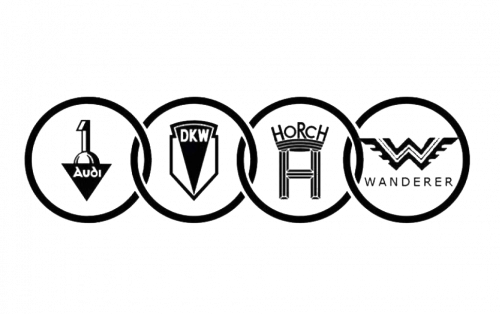
1932–1949: Auto Union Four Rings Logo
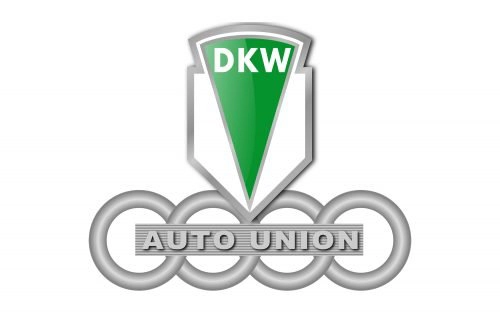
1949–1966: Post-War DKW Triangle
Visual Identity Elements
The DKW typography featured laconic uppercase letters in a massive geometric sans-serif typeface with clean, balanced capitals and straight-cut bar ends. Similar fonts include styles like Neuzeit Grotesk Black or Clarika Pro Geometric Heavy. The color palette consisted of green for progress and development, gray and silver for balance and confidence, and white for transparency and trustworthiness. This simple, bold, and distinctive design philosophy helped the brand stand out through its fresh and lively color scheme.
Direct Links Between Brand Events and Logo Changes
The 1932 merger directly caused replacement of the standalone DKW triangle dkw logo with the four-rings Auto Union logo. The 1949 re-establishment in West Germany triggered return to the pre-war green triangle logo. The dkw logo meaning remained tied to the brand’s core identity despite ownership changes. Logo consistency outside of merger-related updates reflected the continuity of the DKW car symbol through different eras. The final logo era from 1949 to 1966 coincided exactly with the last phase of independent DKW car production before the transition to Audi branding. The dkw emblem evolved only at major corporate milestones while preserving its recognizable triangle shape.
The dkw logo history shows remarkable stability across decades with changes occurring only at key moments such as the Auto Union merger and postwar restart. Many fans look for dkw logo png, dkw logo transparent, and dkw logo hd versions to study these clean geometric forms. The dkw symbol continues to represent an important chapter in automotive history as part of the Audi lineage.