Key facts
- Founded
- 1909
- Founded by
- August Horch
- Country
- Germany
- Headquarters
- Ingolstadt, Germany
- Parent company
- Volkswagen Group
- Legal name
- AUDI AG
- Famous models
- A3, A5, A6, Q5, Q6 e-tron
- Slogan
- “Vorsprung durch Technik”
- Website
- www.audi.com/en.html
Audi logo meaning: what the four rings stand for
The four rings stand for a merger. From left to right, each ring in the Audi logo represents Audi, DKW, Horch or Wanderer, the Saxon companies that joined forces as Auto Union in 1932. The Audi symbol was that group’s emblem first and became the Audi emblem on the cars only decades later.
Auto Union AG was formed in Chemnitz on 29 June 1932, on the initiative of the State Bank of Saxony. Audiwerke, Horchwerke and DKW’s maker, Zschopauer Motorenwerke J. S. Rasmussen, merged outright, while Wanderer brought in its car division through a purchase-and-lease agreement. The result was the second-largest motor-vehicle group in Germany.
Audi’s own explanation is brief: the rings represent the “inseparable unity” of the four founding companies. Dealer pages that explain the Audi symbol meaning often add readings such as harmony or continuity, but those are their commentary, not Audi’s. The car logo with four circles is Audi’s, and the Audi car symbol on almost every model still points back to those four firms. For other badges built on the same shape, see car logos with rings.
| Ring (left to right) | Company | Founded, home town | Role in Auto Union |
|---|---|---|---|
| 1 | Audi | 1909, Zwickau | Deluxe upper-mid-size cars |
| 2 | DKW | J. S. Rasmussen’s firm, Zschopau; DKW name from 1916 | Motorcycles and small cars |
| 3 | Horch | 1899, Cologne; in Zwickau from 1904 | Luxury cars |
| 4 | Wanderer | 1885, Chemnitz | Mid-size cars |
The four companies behind the rings
By 1932 all four were German car brands based in Saxony, and each covered a different price range.
- Audi won the International Austrian Alpine Rally in 1912, 1913 and 1914. With the Type K of 1921 it became the first German maker to switch to left-hand drive. Rasmussen, DKW’s owner, bought a majority of Audiwerke in 1928.
- DKW was J. S. Rasmussen’s company in Zschopau, named after a 1916 steam-car project, the Dampf-Kraft-Wagen. By the late 1920s it built more motorcycles than any other company, and in 1931 it launched the DKW Front.
- Horch was August Horch’s first company, founded in Cologne in 1899 and based in Zwickau from 1904. As the group’s luxury brand it built straight-eight cars from 1926 and a twelve-cylinder model from 1931.
- Wanderer began in Chemnitz in 1885 as Winklhofer & Jaenicke, a bicycle maker, and took the Wanderer name in 1886. Its first production car, the Puppchen, arrived in 1913; the W 10 and W 11 followed in 1926 and 1928.
What does Audi mean? How August Horch’s name became Latin
Audi is Latin for “listen!”, a translation of the founder’s surname, Horch. In German, “horch!” means “listen!” or “hark!”, and “audi” is the same command in Latin, from the verb audire. The name is a word, not an acronym.
August Horch (1868–1951) had headed motor-vehicle production at Carl Benz’s company in Mannheim before founding A. Horch & Cie. in 1899. His second company, August Horch Automobilwerke GmbH, was set up in Zwickau on 16 July 1909, the date Audi counts as its founding. A court then ruled that the Horch name belonged to his former company.
The new name came up in Franz Fikentscher’s flat in Zwickau, where, as the story goes, Fikentscher’s son, a Latin student, suggested translating “Horch.” Audi Automobilwerke GmbH was registered on 25 April 1910, and the first Audi, the Type A 10/22 hp Sport-Phaeton, was delivered that May.
So the answer to who founded Audi is August Horch, whose first company became the Horch brand in the third ring.
How the Auto Union emblem became the Audi logo
The logo of Audi has belonged to four companies at once. The rings were created as Auto Union’s group emblem, stayed in the background of Audi’s identity for decades, and moved to the front only in 1995, when they replaced the red Audi oval.
- 1932–1939: On the road, Audi, DKW, Horch and Wanderer cars kept their own names and badges. The group’s Grand Prix racing cars of 1934 to 1939, the “Silver Arrows,” carried the Auto Union name and rings.
- 1939: The Audi name vanished from new cars for more than two decades. In 1938 Audi had just 0.1 percent of the German car market, against DKW’s 17.9 percent.
- 1948–1949: The Soviet authorities expropriated Auto Union AG, which was struck from the Chemnitz register in August 1948. Auto Union GmbH was founded in Ingolstadt on 3 September 1949 to carry on the four-ring tradition.
- 1958–1965: Daimler-Benz took control in 1958. Volkswagen took over from late 1964, and its executives at first had the Auto Union name and four-ring flags removed from the Ingolstadt factory. The Audi name returned in 1965 on the F103.
- 1969: The NSU merger created Audi NSU Auto Union AG in Neckarsulm. Logo histories say the four rings then became the Audi car logo.
- 1978–1995: After the NSU brand ended in 1977, a black, later red, Audi oval took precedence, shown next to the VW roundel at V.A.G dealers.
- 1995: Once Audi had its own dealer network, the oval was dropped and the rings became the main logo.
Audi logo history: every version from the first script to 2016
The old Audi logo was not one design. Audi and its predecessors used about ten versions up to 2016, under four different company names. The table lists all 12 versions, including the two newer marks covered in the next section.
| # | Version | In use | What it looked like | Used by |
|---|---|---|---|---|
| 1 | Early script in an oval | First years (date unconfirmed) | Flowing “Audi” script set diagonally in a thin oval | Audi Automobilwerke |
| 2 | Lucian Bernhard script | 1920–1939; revived 1965 | ”Audi” lettering with slanted tails on the A and d | Audiwerke; Auto Union from 1965 |
| 3 | Numeral “1” | From 1923 | A “1” rising from a half-sphere, “Audi” script below | Audiwerke |
| 4 | Rings with marque badges | From 1932 | Four rings, each holding a company badge | Auto Union AG |
| 5 | Rings with AUTO UNION | 1949–1969 | Plain rings crossed by an AUTO UNION name bar | Auto Union GmbH |
| 6 | Rings as car badge | 1969–1994 | Four plain rings on the cars, no text | Audi NSU; AUDI AG from 1985 |
| 7 | Audi oval | 1978–1994/95 | Black, later red, ellipse with “Audi” lettering | Audi NSU; AUDI AG |
| 8 | 3D silver rings | 1995–2009 | Chrome-shaded rings above a red “Audi” | AUDI AG |
| 9 | Centenary rings | 2009–2016 | Larger glossy rings, red “Audi” in Audi Type at bottom left | AUDI AG |
| 10 | Flat 2D rings | 2016–present | Four flat black rings, no wordmark | AUDI AG |
| 11 | Black-and-white car badge | 2022–present | White rings with a thin black border, no chrome | AUDI AG |
| 12 | AUDI wordmark | 2024–present, China only | Capital-letter “AUDI,” no rings | Audi’s China sub-brand with SAIC |
c. 1910: the first Audi script in an oval
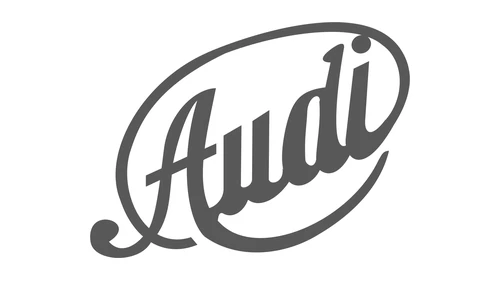
The earliest mark in logo archives is a flowing “Audi” script set diagonally inside a thin oval, in a single dark color. Fan sites place it in Audi’s first years, but no primary source confirms the date, so treat it as an early script wordmark, not a dated first logo.
1920: Lucian Bernhard’s Audi lettering
In 1920 the graphic designer Lucian Bernhard drew the “Audi” lettering with slanted tails on the capital A and the lowercase d. When the Audi name came back in 1965, this script was revived, and a curved d stayed in the Audi wordmark through the oval and the 1995 logo.
1923–1932: the numeral “1” on a half-sphere
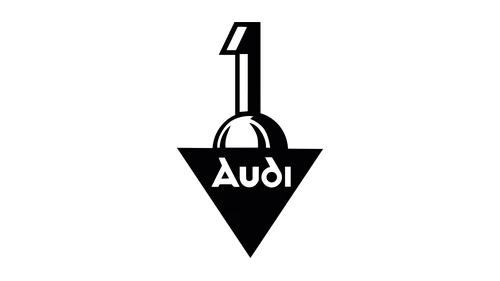
From 1923, the logo Audi put on its radiators was a stylized numeral “1” rising from a half-sphere, with “Audi” in script below. Arno Drescher and Hermann Gilbert designed it. Logo archives show the enamel-sign version inside a black, downward-pointing triangle, the form that later filled Audi’s ring in the Auto Union emblem. Some sites date this mark to 1909, but histories of Audiwerke give 1923.
1932: Auto Union’s four rings with the marque badges
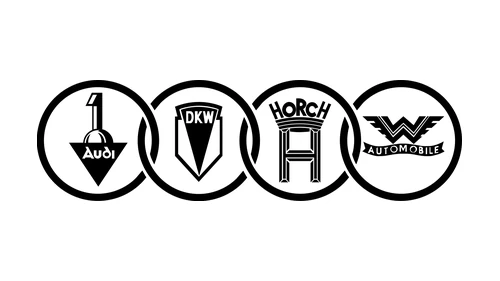
What many sites call the original Audi rings were Auto Union’s. One version of the 1932 emblem placed each company’s badge inside its ring, left to right: Audi’s numeral-1 triangle, the DKW shield, Horch’s crowned H and Wanderer’s winged W. Old artwork shows the rings in different colors, and no reliable source fixes the original one.
1949–1969: plain rings and the AUTO UNION name
Auto Union GmbH in Ingolstadt used the four rings with its own name. The usual artwork shows four empty rings crossed by a horizontal bar with AUTO UNION in capitals, and the company badges are gone. The exact artwork and colors of this period are poorly documented.
1969–1994: the four rings as the Audi badge
Under Audi NSU Auto Union AG, the four plain rings became the Audi badge on the cars, according to logo histories. The badge carried no text. Reconstructions often show blue rings, but no reliable source confirms the color.
1978–1995: the Audi oval
From 1978 the leading Audi mark was an oval, not the rings: a horizontal ellipse, black at first and later red, with white “Audi” lettering and its curved d inside. The oval framed the word, never the rings. It ran until 1994/95 and was retired once Audi had dealers of its own, separate from Volkswagen’s.
1995–2009: 3D silver rings and a red Audi wordmark
In 1995 the rings returned to the front as a shaded, three-dimensional silver emblem, with a red “Audi” wordmark centered below. From 1997 the corporate typeface was Audi Sans, based on Univers Extended and drawn by Ole Schäfer for MetaDesign.
2009–2016: the centenary rings and Audi Type
For Audi’s centenary, the logo was redrawn and shown at the IAA in Frankfurt in September 2009. The rings grew larger, with new chrome shading, and the red “Audi” moved to the bottom left in the new Audi Type. For the first time, the rings were paired with the slogan “Vorsprung durch Technik.” Audi Type came from the Bold Monday foundry, commissioned through MetaDesign; credit for the logo itself is disputed.
2016: flat black 2D rings
In April 2016 Audi replaced the chrome artwork with four flat black rings, with no gradients and no wordmark in the lock-up. Audi describes two-dimensional rings as a consequence of digitalization. This is still the corporate logo, black on white. From 2019 the flat look reached the outside of the cars as well.
What is Audi’s new logo?
Audi’s new logo depends on where you look. The corporate Audi logo is still the flat black rings of 2016, while the Audi car logo, the badge on the cars themselves, has been chrome-free black-and-white rings since 2022. In China only, a sub-brand launched in 2024 uses an AUDI wordmark without rings. Worldwide, the real logo of Audi is still the four rings.
2022: chrome-free black-and-white rings on the cars
In November 2022 Audi announced the new Audi logo for its cars. The black-and-white Audi logo of 2022 drops chrome entirely: the rings are two-dimensional, in high-contrast white with a thin black border, and their geometry is almost unchanged. The badge appeared first on the Q8 e-tron. The redesign is credited to André Georgi. Audi’s announcement framed it around purity, reduction and consistency: the badge on the car now matches the flat rings used on screens and in print since 2016.
2024: the AUDI wordmark for China, without the rings

In November 2024 Audi showed the AUDI E concept with a plain capital-letter AUDI wordmark and no rings. The wordmark belongs to a separate sub-brand developed with the Chinese carmaker SAIC, and its first model, the E5, was presented in April 2025. Despite “Audi new logo” headlines at the time, it is not a global replacement: every Audi sold outside that sub-brand, in China and elsewhere, keeps the four rings.
Audi logo PNG: which version to use
The Download button above gives the current Audi logo PNG: four flat black rings on a transparent background, the corporate artwork used since 2016. It suits most documents, slides and websites.
- Light backgrounds: the black rings as downloaded.
- Dark backgrounds: the same rings in white. A single-color logo inverts cleanly, which a chrome one does not.
- Historical projects: the 1995–2009 chrome rings or the 2009–2016 centenary artwork, labeled as older versions rather than the current logo.
Single-color artwork also suits embroidery, vinyl cutting and engraving, which cannot reproduce gradients or chrome.
Audi Sport logo and RS badge
Neither the Audi Sport logo nor the Audi RS logo is part of this download; both are separate marks. Audi Sport GmbH, the Neckarsulm subsidiary behind the Audi Sport brand, was called quattro GmbH until November 2016.
Frequently asked questions
Is the Audi logo based on the Olympic rings?
Audi does not say so and names no designer. Popular accounts credit Wanderer sales chief Klaus von Oertzen with the idea and link it to the Olympic rings, but the story has no official backing. It is often reported that the IOC challenged Audi over the rings in 1995 without success; no court record of the case is known.
Do the four rings spell A-U-D-I?
No. The rings are not letters, and none of them stands for a single character of the name. Each ring stands for a company: Audi, DKW, Horch or Wanderer. The A-U-D-I reading turns up on some websites, but Audi's own account of the emblem refers only to the four founding companies of Auto Union.
Is Audi a German car brand?
Yes. Audi is a German car brand, and Audi's country of origin is Germany. The company was founded in Zwickau, Saxony, in 1909 and has had its head office in Ingolstadt, Bavaria, since 1985. Its parent, Volkswagen, is German as well, so Audi is neither a Swiss nor an Italian brand.
Is Audi owned by Volkswagen?
Yes. AUDI AG has been a wholly owned subsidiary of Volkswagen AG since November 2020, when the last minority shareholders were squeezed out. Volkswagen has controlled the business since the mid-1960s, but Audi still runs as its own brand, with a separate head office in Ingolstadt, its own model range and its own four-ring logo.
Who came first, Audi or BMW?
Audi. August Horch founded the company that became Audi on 16 July 1909, while BMW dates its founding to 1916. That makes Audi seven years older. If you count Horch's first car company, set up in 1899 and later one of the four rings, the Audi family tree goes back 17 years further than BMW's.
What is Audi's slogan?
Audi's slogan is "Vorsprung durch Technik," German for "progress through technology." The company adopted it in January 1971 and still uses it as its brand claim. In the United States, Audi has also advertised with the English tagline "Truth in Engineering" since 2007.
What is Audi's full company name?
The legal name is AUDI AG, written in capital letters. From the 1969 merger with NSU until 1 January 1985 the company was called Audi NSU Auto Union AG, and its head office was in Neckarsulm. With the change to AUDI AG, the head office moved to Ingolstadt, where it still is.
What does a black Audi logo mean?
On a new Audi, black rings usually point to the black-optic styling option. On the chrome-free badge introduced in 2022, that option replaces the white parts of the rings with a high-gloss dark grey, so the whole emblem looks black. In print and online, flat black rings are simply Audi's standard corporate logo.
Does Audi have a sound logo?
Yes. Besides the four rings, Audi uses an audio trademark: a sound logo built around the sound of a beating heart. It has been in use since 1996, and Audi updated it in 2010. It plays the same role for the ear that the rings play for the eye in the brand's advertising.