

Key facts
- Founded
- 1899
- Founded by
- Johann Puch
- Country
-
 Austria
- Headquarters
- Graz, Austria
- Parent company
- Steyr-Daimler-Puch
- Famous models
- Voiturette, Alpenwagen, 500, G
The Puch logo is a round black badge with the name PUCH in white capitals above a green and white chequered shield. Puch is an Austrian maker of bicycles, mopeds, motorcycles and cars from Graz, and its brand now belongs to Cycleurope.
Puch Logo
The Puch emblem is a circle with a white ring around a black field. The name PUCH sits across the top in bold white letters, and below it a shield is split into green and white squares. The design uses black, green and white.
The shield works as the Puch badge and the Puch symbol on bicycles, mopeds and cars alike, and it is the Puch car logo of the Graz-built vehicles. This page offers the Puch logo PNG with a transparent background.
What the Puch logo means
The green and white chequered badge uses the colours of the Steyr town flag. The idea is close to the BMW badge, which takes the colours of the Bavarian flag. Its Puch logo meaning is therefore local: it ties the brand to Styria.
Puch Logo History
Puch logo evolution starts with bicycle badges. The old Puch logo from the early 1890s is a narrow plate for the Styria bicycles of Joh. Puch & Comp. in Graz.
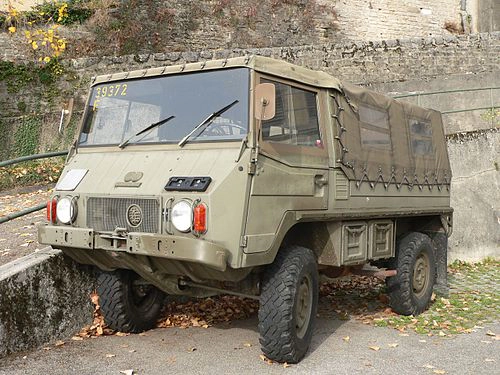
After the new bicycle company was founded in 1899, the bicycle head badge showed the chequered shield in green and silver with the name PUCH on top.

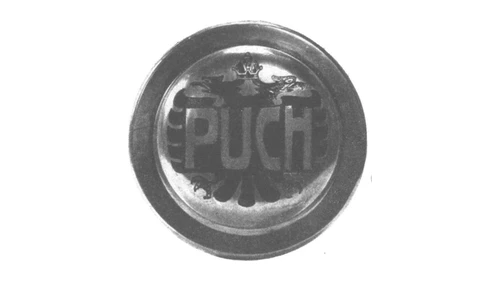
A hub cap from 1913 for wire-spoke wheels carries a round PUCH emblem.
From 1935 the Puch badge appears next to the round Steyr emblem in the combined Steyr-Puch emblem, which was used until 2002.
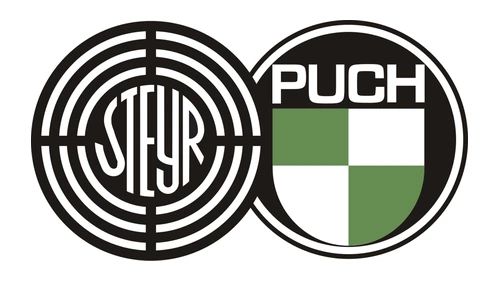
The new Puch logo, in use from around 1987, is the black roundel with the green and white shield, which also exists as a black and white variant.


Puch History
Johann Puch worked from 1889 as an agent for Humber vehicles and as a maker of Styria safety bicycles in a small workshop in Graz. In 1890 he founded Johann Puch & Comp., left it in 1897 after a dispute and founded the First Styrian Bicycle Factory in Graz two years later.
The company added engines in 1901 and cars in 1904, and in 1909 a Puch car set a world speed record of 130.4 km/h. The four-cylinder Alpenwagen followed in 1913.
Puch merged with Austro-Daimler in 1928 and with Steyr in 1934, forming Steyr-Daimler-Puch. The Puch 500, based on the Fiat 500, was built from 1957 to 1975. In 1979 a joint venture with Mercedes-Benz began building the G-Class in Graz. In 1987 two-wheeler production in Graz ended and the motorcycle company was sold to Piaggio, and in 1997 the bicycle division went to Cycleurope. A Puch museum opened in 2003.
Puch Logo PNG and Colors
The current Puch logo file on this page is a PNG image of 1573 × 1574 pixels, the design in use since 1987. Older versions from the history above open in the logo switcher under the main image.
| Colors | Green, Black, White |
|---|---|
| Shapes and motifs | Shields, Circles |
| Logo versions | 6, since 1890 |
| Current logo | Since 1987 |
| File | PNG, 1573 × 1574 px |
Frequently asked questions
Who founded Puch?
Puch was founded in 1899 by Johann Puch.
What does the Puch logo mean?
The green and white chequered shield takes the colours of the Steyr town flag, a concept similar to the BMW badge, which uses the colours of the Bavarian flag.
What country is Puch from?
Puch is an Austrian car brand, headquartered in Graz, Austria.
Who owns Puch?
Puch is owned by Steyr-Daimler-Puch.
Did Puch change its logo?
Yes. Puch has used six logos since 1890. The current logo dates from 1987.
What color is the Puch logo?
The current Puch logo is green, black and white and features a shield and a circle.
What cars does Puch make?
Well-known Puch models include the Voiturette, Alpenwagen, 500 and G.