Key facts
- Founded
- 1994
- Founded by
- Christian von Koenigsegg
- Country
- Sweden
- Headquarters
- Ängelholm, Sweden
- Legal name
- Koenigsegg Automotive AB
- Famous models
- Agera, Jesko, Gemera, CCX, Regera, CC8S
- Website
- www.koenigsegg.com
Koenigsegg logo meaning: the family crest behind the shield
The Koenigsegg logo is the von Koenigsegg family coat of arms turned into a car badge. Designer Jacob Låftman drew it in 1994, the year Christian von Koenigsegg founded the company, as a heraldic shield filled with red and yellow diamonds inside a blue frame.
The arms are much older than the cars. They have been the family’s crest since the 12th century, when a member of the family was knighted by the Holy Roman Empire. So the Koenigsegg symbol is a family emblem the founder put on his cars, not a shape invented for marketing.
Koenigsegg has not published a meaning for each color or diamond, so logo sites that assign one, or list exact color codes, have no source for it.
The shield and diamond pattern
The Koenigsegg crest is a shield divided into a rhombus, or diamond, pattern. The right half is shaded darker than the left, which gives the badge a three-dimensional look. It belongs with other car logos with shields.
At the top sits a small ornament shaped like a mirrored pair of Cs joined by a vertical bar. One car site says it stands for Koenigsegg CC, after the company’s first car, and that it is the only part changed from the family arms. The shape fits that reading, but Koenigsegg has not confirmed it.
Despite the sharp angles, the Koenigsegg emblem contains no triangles, only diamonds.
Colors: red, yellow and blue
The full-color Koenigsegg logo uses yellow, often described as gold, and red diamonds on a blue frame. Some sources call the red burgundy.
- Full color: yellow and red diamonds, blue frame, gold ornament at the top.
- On the cars: metal, black-and-white or gold-and-black finishes, depending on the model.
The wordmark
The wordmark sits under the shield in the full Koenigsegg logo. It uses bold, slightly italic, mixed-case letters with rounded angles.
A thick underline runs beneath the name, but it breaks around the tails of the three Gs so it never touches them. Some logo sites describe the lettering as condensed uppercase, which it is not.
Koenigsegg ghost logo: why is there a ghost on every car?
The Koenigsegg ghost logo honors the Johan Röd squadron, the first fighter division of Swedish Air Force wing F 10, which flew from the Ängelholm air base where Koenigsegg now builds its cars. The squadron’s pilots and crew offered the ghost to the company as a tribute.
The Ghost Squadron of Ängelholm
F 10, known in English as the Scania Wing, was based at Ängelholm from 1945 until it was disbanded in 2002. Its first fighter division used the call-sign name Johan Röd; the other two were Johan Blå and Johan Gul.
The ghost was that division’s insignia, carried on its Saab AJS 37 Viggen jets. As for the name, Koenigsegg says the squadron took off early in the morning and flew until dusk, so people on the ground heard the jets above the clouds but rarely saw them, hence the “Ghost Squadron.” Other retellings give different flying hours.
How the ghost came to Koenigsegg
The company started in Olofström and moved to Margretetorp in early 1999. On February 22, 2003, a fire badly damaged the thatched-roof building there and destroyed many early records.
Koenigsegg then took over the disused Ängelholm air base. In late 2003, one of its two fighter-jet hangars and an office building became the new factory, and the old runway is still used for testing. The F 10 pilots and crew gave the newcomers their ghost and asked that it go on each car built at their former home.
Where to find the Koenigsegg ghost
The ghost is not part of the shield in the Koenigsegg logo. It is a separate Koenigsegg badge on the rear hood, over the engine bay, of every car the company builds.
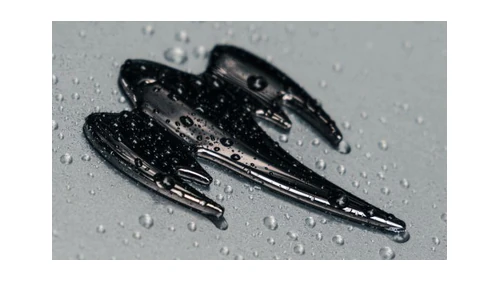
Koenigsegg calls this second symbol the “Spirit of Performance,” and it also appears on the brand’s clothing and jewelry. The company still uses it on current cars, including the Jesko.
Why does Koenigsegg have two logos?
Koenigsegg has two logos because the two symbols come from different places. The shield is the brand logo, taken from the founder’s family arms in 1994. The ghost is a tribute badge that arrived in 2003, when the company moved into the former air base of the squadron whose insignia it was.
| Symbol | What it is | Origin | Where you see it |
|---|---|---|---|
| Shield with wordmark | The brand logo | von Koenigsegg family coat of arms, drawn by Jacob Låftman in 1994 | The emblem on the cars and the full logo in brand use |
| Ghost | A tribute badge, the “Spirit of Performance” | Insignia of F 10’s Johan Röd squadron, adopted in 2003 | Rear hood over the engine bay; clothing and jewelry |
| Black-and-white shield | A single-color version of the same shield | Same crest, no new design | Newer models |
What is the real logo of Koenigsegg?
The real Koenigsegg logo is the shield, alone or with the wordmark beneath it. Wikipedia describes the shield as the company’s badge and gives the ghost its own section, and Koenigsegg’s own site calls the ghost the squadron’s symbol and a tribute. Fans call the ghost an Easter egg on every car. It sits beside the Koenigsegg crest and does not replace it.
Koenigsegg logo history: evolution from 1994 to today
The Koenigsegg logo has changed very little. The shield has stayed essentially the same since 1994, and what varies is the color treatment and finish. The only real addition came in 2003, when the ghost joined the cars as a second badge.
1994 to present: the shield and wordmark
Jacob Låftman’s 1994 design pairs the full-color shield, with its gold mirrored-C ornament at the top, with the black underlined wordmark below. The same lockup is still the full-color Koenigsegg logo today. It came before the cars: the first CC prototype was finished in 1996, and the CC8S of 2002 was the first street-legal production model.
2003 to present: the ghost badge
From late 2003, when production moved into the former F 10 hangar, the Johan Röd ghost began to appear on the cars. It is a standalone badge with no shield and no wordmark (pictured above).
Black-and-white version of the shield
Newer Koenigsegg models also show the shield in black and white: the same outline, with the diamonds and the top ornament in solid black and no wordmark. No source gives a start year, so it is a color variant rather than a new era.
Is there a new Koenigsegg logo?
No redesign is documented. Some logo sites list a separate logo from 2022, but none describes what changed, and the image they show is this black-and-white shield. A claimed 2000 refinement has no reliable source either.
Koenigsegg badge on the car: placement and variants
Every Koenigsegg carries two badges: the shield, or Koenigsegg emblem, and the ghost. The Koenigsegg car logo takes a finish that suits the model rather than one fixed color scheme.
- The shield emblem: metal, black-and-white or gold-and-black, depending on the model.
- The ghost: on the rear hood, over the engine bay.
- Off the car: the ghost on Koenigsegg clothing and jewelry.
The Koenigsegg Jesko logo is the standard one: the Jesko, named after Christian von Koenigsegg’s father, wears the same shield and ghost as the rest of the range.
Don’t confuse the ghost badge with the Agera’s “Ghost Light,” an interior lighting technique unrelated to the squadron.
Koenigsegg logo PNG and permitted use
The Koenigsegg logo PNG on this page is the full-color shield with the wordmark on a transparent background, available through the download button above.
The Koenigsegg logo belongs to Koenigsegg Automotive AB. Showing it to identify the brand in articles, reviews or school work is common practice, while putting it on products or advertising generally needs the company’s permission. This is general guidance, not legal advice. For more brands from the same country, see our list of Swedish car brands or other hypercar brands.
Frequently asked questions
Is a Koenigsegg a Bugatti?
No. Koenigsegg and Bugatti are separate companies that happen to compete in the hypercar class. Koenigsegg is Swedish, based in Ängelholm and owned by its founder. Bugatti is French, based in Molsheim, was revived in 1998 under Volkswagen and has been part of Bugatti Rimac since November 2021.
Who is the owner of Koenigsegg?
Founder Christian von Koenigsegg owns the company and runs it as CEO, with Halldora von Koenigsegg as COO. Ownership has not been constant since 1994, though. In January 2019 Koenigsegg sold a 20% stake to the carmaker NEVS for US$171 million, then bought that stake back in 2021, so the founder is again the sole owner.
How much is a Koenigsegg Ghost badge worth?
There is no verified price. Koenigsegg has not published one, and no reliable source gives a value for an original ghost badge from a car, so figures quoted online are guesswork. The Koenigsegg ghost logo also appears on official clothing and jewelry, which is the simplest way to own the symbol without buying a car.
What does Koenigsegg mean in English?
Koenigsegg is a family name, not a word with a standard English translation. The company carries the surname of its founder, Christian von Koenigsegg, whose family coat of arms, in use since the 12th century, became the Koenigsegg logo in 1994. Popular translations found online are not backed by a reliable source.
Is Jesko a Koenigsegg?
Yes. The Jesko is a Koenigsegg model, named after Christian von Koenigsegg's father, Jesko von Koenigsegg. Other model names have meanings of their own, mostly from Swedish. Agera translates as "take action," Regera as "reign" or "rule," and Trevita as "three whites." The early CC cars used coded names instead, such as CC8S and CCX.
What does CCX stand for on a Koenigsegg?
CCX stands for Competition Coupe Ten, a name that marks ten years of the company, which was founded in 1994. The earlier CC8S stands for Competition Coupe V8 Supercharged. Built from 2002, the CC8S was the first street-legal production Koenigsegg, following the first CC prototype of 1996.
Is Koenigsegg a luxury car?
Yes. Koenigsegg builds low-volume hypercars at the top of the luxury market, develops most main systems in-house and makes metal and carbon-fiber parts by hand. In 2017 its Agera RS averaged 447 km/h (277.8 mph) over two runs. The company opened its Gripen Atelier factory in 2023 and employs more than 700 people.
Did Koenigsegg buy Saab?
Koenigsegg did not end up buying Saab. In June 2009 Koenigsegg Group signed a letter of intent to take over the Swedish brand from General Motors. In November 2009 the group withdrew, and the deal never closed.