Key facts
- Founded
- 1948
- Founded by
- Soichiro Honda
- Country
-
 Japan
- Headquarters
- Minato, Tokyo, Japan
- Legal name
- Honda Motor Co., Ltd.
- Famous models
- Civic, Accord, CR-V, Fit, NSX
- Slogan
- “The Power of Dreams”
- Website
- www.honda.com
Honda logo meaning: what the H stands for
Honda calls the mark the “H mark” and has used it on its cars since 1963. The emblem on a grille is the H alone, drawn wider at the top than at the bottom.
So yes, the Honda logo is an H, and it stands for the family name rather than a hidden idea. Honda has not published an official meaning for the shape of the H it used from 1963 until 2025. It only did that for the new version:
- Letter: H for Honda, the family name of Soichiro Honda, who started the company in 1946.
- Shape: an H whose top is wider than its base, which gives the older badges a trapezoid outline. One popular reading compares the shape to an armchair that stands for comfort, but Honda has never said so.
- 2026 meaning: Honda describes its new H mark as drawn “like two outstretched hands.” It says the hands express a commitment to expand what mobility can do and to serve its customers.
Honda also has an older second logo, the Wing, which is used on the motorcycles. The H mark belongs to the car side of the company.
The new Honda logo: the 2026 H mark
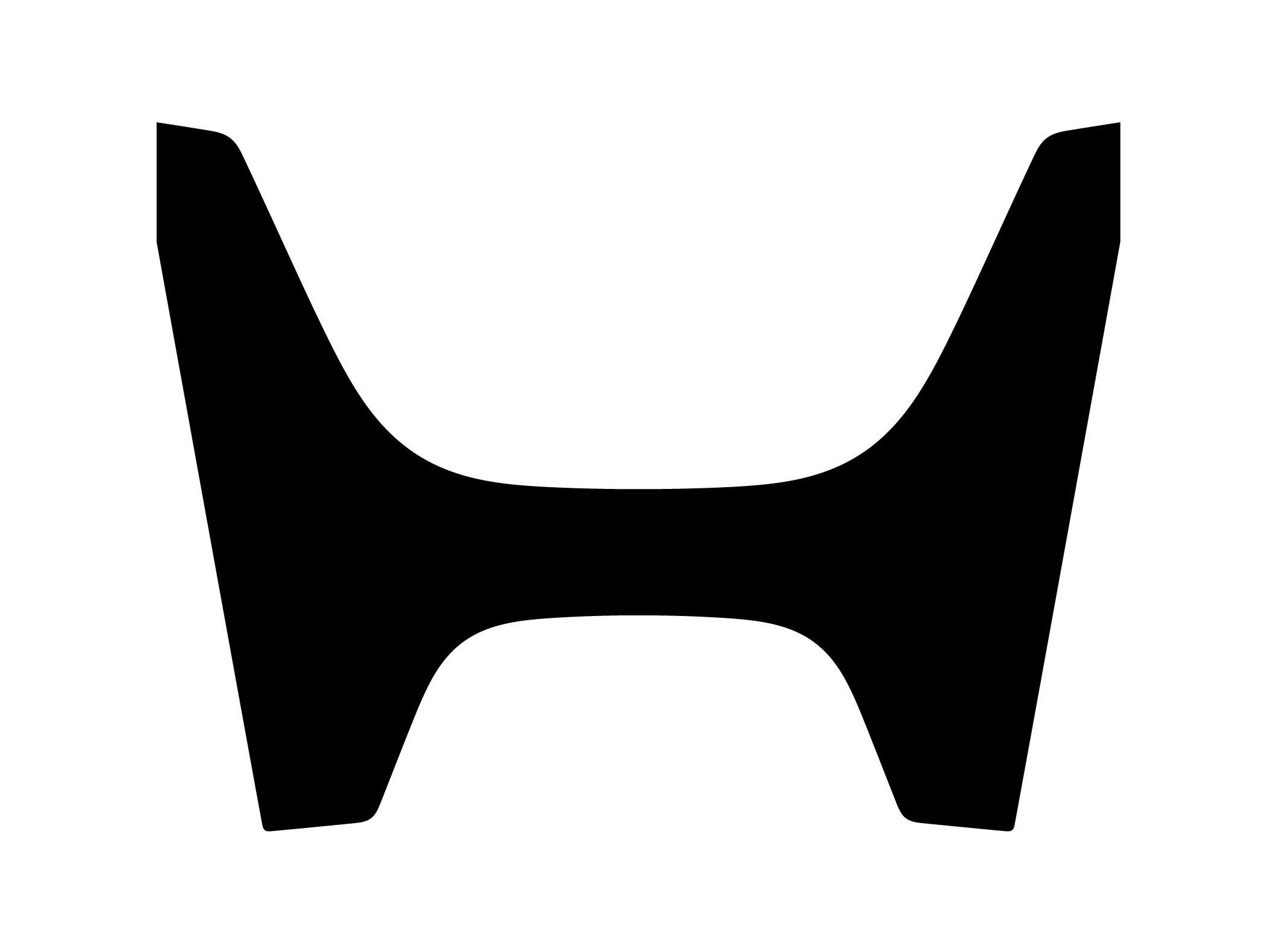
Honda’s new logo is a frameless H mark with two thick uprights joined by a low, U-shaped crossbar. Honda unveiled it at CES in January 2024 for its coming EVs. On January 13, 2026, Honda made it the symbol of its entire car business, and production models get it from 2027.
The first showing was on January 9, 2024, in Las Vegas. The new H mark appeared there on the Honda 0 Series concepts, the Saloon and the Space-Hub. At that point Honda said the mark was reserved for its next-generation EVs. It planned to launch the first 0 Series model and the new H mark in 2026, starting in North America.
The January 2026 announcement widened that scope. The mark will reach Honda cars gradually, starting with next-generation EVs and hybrids launched from 2027. It will also be used at dealerships, in Honda’s communications and in its automobile motorsports.
Why is Honda changing its logo? Honda ties the redesign to its next-generation EVs, including the 0 Series, which it wants to build “from zero” by returning to its starting point as a carmaker. It calls the new mark a symbol of its “second founding.”
Car and Driver and Car Design News call it the first significant change to the Honda car logo since 1981. Several outlets see it as a throwback to the original 1960s H, which also flared outward at the top.
What is the current Honda logo on a car you can buy today? It is still the framed H, not the new Honda logo. Some logo sites list the frameless H as the “2024 to present” logo, but in 2024 it appeared only on concepts. Production cars get it with models launched from 2027.
| Honda | New logo (2026) | Framed H mark (1981 to 2026) |
|---|---|---|
| Frame | None | Thick rounded square around the H |
| Shape of the H | Uprights flare out at the top and meet a U-shaped crossbar | Shorter and rounder |
| Finish | Flat, single-color artwork | Chrome, three-dimensional on cars |
| Where it is used | Next-generation EVs and hybrids, dealerships, communications, motorsports | Honda cars on sale now |
| Official meaning | ”Two outstretched hands” | None beyond the founder’s initial |
| Timing | Unveiled 2024, adopted 2026, on cars from 2027 | Debuted on the 1981 Honda City |
Honda logo history: every H mark since 1963
The Honda logo history on cars has five stages. There is the 1963 original, the slim white H of 1969, the framed H of 1981, a chrome rendering from around 2000, and the new H mark of 2024 to 2026. Honda itself says the mark went through several design changes after 1963.
That contradicts a myth repeated on logo sites, which call Honda’s logo unchanged or “the most conservative logo” of the 20th century. The basic idea has stayed the same since 1963, but Honda has redrawn the H several times.
1963–1969: the first Honda car emblem
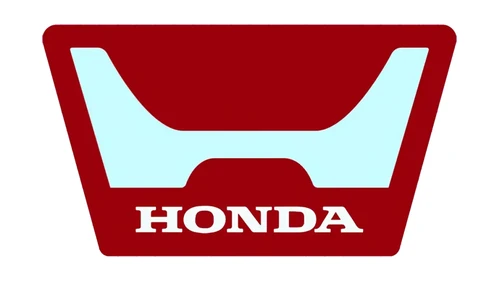
The first logo Honda put on a car was the 1963 H mark. Honda adopted it that year as the symbol of its automobiles, when its first production cars reached buyers. The T360 carried a large H on its front, and the S500 also wore one.
The badge was a dark red trapezoid, wider at the top than at the bottom, with a light-blue H and HONDA lettering beneath the H. Some design histories trace the first H artwork to 1961, but Honda dates the mark to 1963.
1969–1981: a slim white H on black

In 1969 the H became taller and slimmer, white on a black background. The HONDA lettering was dropped, leaving the H on its own. This version debuted on the Honda 1300.
1981–2026: the framed H
In 1981 Honda drew a shorter, rounder H and set it inside a thick rounded-square frame, which some writers call a ring or a “square circle.” It debuted on the Honda City. This framed H remained the basis of the Honda logo on cars for more than four decades.
In print, a heavy uppercase serif HONDA wordmark sat under the framed H. The wordmark was never part of the car badge.
About 2000: the chrome H with a red wordmark
From around 2000, Honda usually showed the framed H as a chrome, three-dimensional emblem next to a red HONDA wordmark. Several logo sites list this as a redesign, but the H kept its 1981 shape. Only the finish and the color of the wordmark changed.
2026–present: the frameless new H mark
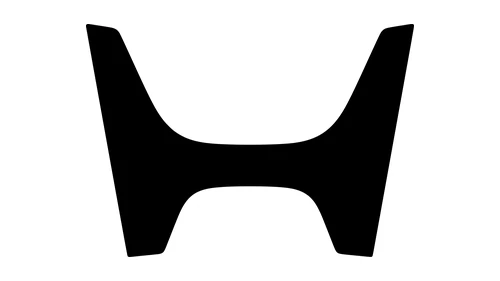
The new H mark drops the frame and has the wide-topped stance of the 1963 original again. Honda showed it in 2024 and adopted it for the whole car business in 2026. It appears on production cars from 2027, as described in the section above.
Why does Honda have two logos? The H mark and the Wing
There are two Honda logos because its motorcycles and its cars grew up with separate marks. The Wing came first, in 1948, and stayed with the motorcycles. The H mark arrived in 1963 as the symbol of Honda automobiles. In short, the Honda cars logo is the H, and the Honda Motor logo on motorcycles is the Wing.
From 1968 to 2000, Honda used the Wing as its official logo on all products. That describes company-wide marking. Honda cars kept the H on their grilles throughout those years.
The idea came from Soichiro Honda. He wanted the company to aim for first place in the world, not just in Japan, and he asked for an image of flying across the globe. Honda says the wing motif is thought to be inspired by the wings of the Nike of Samothrace, the Greek statue, and by the eagle. In Honda’s words, the Wing conveys flight, reliability, speed, tradition and honor.
Honda’s luxury brand, Acura, dates from 1986 and has its own page. Honda’s own timeline of the Wing has eight stages.
1948: a winged female figure
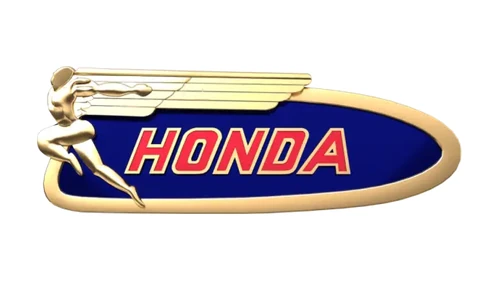
The first stage, from the year Honda Motor Co., Ltd. was incorporated, shows a female figure soaring through the sky. She has wings, and she sits on a blue badge with HONDA lettering. A cursive “Honda Motor” banner that some sites date to 1947 is not part of Honda’s timeline.
1953: the first wings
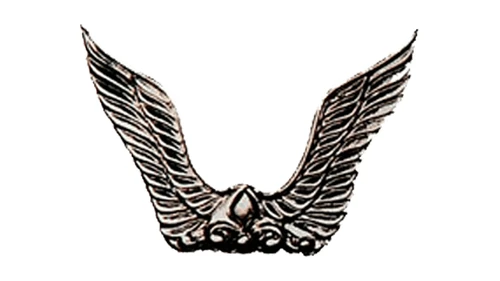
In 1953 wings appeared in the Honda mark for the first time, as a pair spread to the left and right. Logo sites that run this design until 1968 are wrong. A single wing replaced it in 1955.
1955: the first single wing
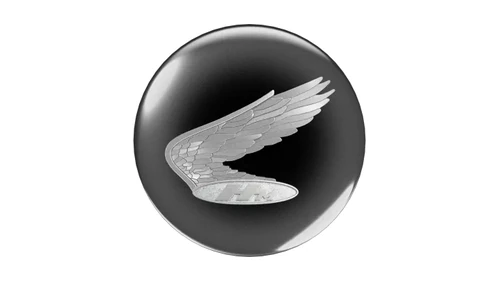
The Dream SA motorcycle of 1955 carried the first single-wing logo, which is the direct ancestor of today’s Wing. Honda set the wing to face forward on both sides of the fuel tank.
1960: a painted wing
In 1960 the Wing became a painted mark, lighter than the earlier badges.
1968: fewer feathers
The 1968 update simplified the wing, with fewer feathers and a more consistent look. It is also the year the Wing became Honda’s official logo on all products, a role it kept until 2000.
1972: the Wing with a name
In 1972 Honda combined a new wing with the Honda name, turning the mark into a logo with a name. Many logo sites date this version to 1973, but Honda’s own date is 1972.
1988: a design proposed by employees
The 1988 Wing was proposed by Honda employees. It is an abstract red wing with red HONDA lettering below. A red, white and blue wing that some sites place between 1985 and 1988 does not appear in Honda’s timeline.
2001: the Wing today
Honda updated the Wing again in 2001, and that refined red wing with the HONDA wordmark is the one in use today.
The Honda badge on the car: chrome, black and red
The Honda car logo is the H alone, without the HONDA name. On current models it is the framed H in chrome. The frameless H replaces it gradually, starting with next-generation EVs and hybrids launched from 2027. The HONDA wordmark appears under the H only in corporate and print versions.
- Chrome: the usual finish of the framed Honda badge on cars since 1981, and the look of Honda’s 3D artwork from around 2000.
- Black: the framed H is printed black on white, and the 1969 to 1981 badge put a white H on a black field.
- Red: red H badges are linked with Honda’s Type R models. One automotive outlet traces the red to the RA272, the Honda Formula 1 car that won the 1965 Mexican Grand Prix, but Honda’s logo announcements don’t mention it.
Cars built before the switch keep the framed H. The new badge arrives with new models rather than as a change to existing ones.
Honda vs Hyundai logo: how to tell them apart
Honda and Hyundai do not share a logo, and they are separate companies. Both the Honda symbol and Hyundai’s badge show an H. Honda’s H stands upright and is wider at the top, while Hyundai’s H is slanted and sits inside an oval. Honda is one of the Japanese car brands, and Hyundai is South Korean.
Honda is also the older company. It started in 1946 and was incorporated in 1948, while Hyundai was founded in 1967.
| Honda | Hyundai | |
|---|---|---|
| The H | Upright, wider at the top | Slanted |
| Frame | Rounded square from 1981 to 2026, none on the new mark | Oval |
| What the letter refers to | Founder Soichiro Honda’s surname | The company name |
| Country | Japan | South Korea |
| Company founded | 1946 (incorporated 1948) | 1967 |
Honda logo design: font and colors
The Honda wordmark is custom: HONDA in heavy uppercase letters with slab-style serifs. Honda has not published a name for the typeface, so claims that it is Clarendon or a similar face are guesses. The wordmark is red, and the H appears in chrome, black or white.
- Red: the color of the HONDA wordmark and of the Wing since 1988. If Honda has a signature color in its logos, it is this red.
- Chrome and silver: the framed H on cars, and the 3D rendering used from around 2000.
- Black and white: the one-color versions. The black-and-white version goes back to the 1969 badge, and Honda presents the new H mark as flat single-color artwork.
- Dark red and light blue: the colors of the first badge, from 1963.
Honda logo PNG, transparent and black-and-white versions
The Download button at the top of this page gives a Honda logo PNG of the new H mark: a black frameless H on a transparent background, made from the artwork Honda published in January 2026. The chrome framed H with the red HONDA wordmark is shown in the history above, and the framed H is still the badge on Honda cars sold today.
Depending on the job, you may need one of these other versions:
- Honda logo in black or white: the framed H as flat one-color artwork, for printing.
- Honda new logo (2026): the frameless H mark, for anything about models launched from 2027.
- Honda Wing: the mark for Honda motorcycles.
- HONDA wordmark: the red lettering on its own.
For a transparent Honda logo, remove the white background in an image editor. The H mark and the Wing are Honda trademarks, so they are fine for reference and editorial use but not for your own products.
The Honda Logo car (1996–2001)
The Honda Logo car was a small supermini hatchback that Honda built from 1996 to 2001. That is why the Wikipedia article titled “Honda Logo” is about a car and not the emblem. The model shares nothing with the H mark except the name.
Frequently asked questions
Did Honda start with motorcycles?
Not quite. Honda began in 1946 by building engines for bicycles, which turned them into motorized bicycles, and only then moved on to complete motorcycles. Honda has been the world's largest motorcycle manufacturer since 1959, a position it still holds today.