Key facts
- Founded
- 1953
- Founded by
- Beijing Municipal Government
- Country
- China
- Headquarters
- Qingdao, China
- Parent company
- Shandong Weiqiao Pioneering Group
- Legal name
- Beijing Automobile Works Co., Ltd.
- Famous models
- BJ212, BJ2020, Warrior, Yusheng, Ruisheng M8
- Website
- www.bawauto.com
BAW Logo History and Brand Evolution
Beijing Automobile Works Co., Ltd. began as The First Accessory Factory in 1953 in Beijing. It received its formal name in 1958 when it became Beijing Automobile Works. The company later underwent several major restructurings that shaped both its business direction and visual identity.
Ownership and Corporate Timeline
The corporate journey of Beijing Automobile Works includes several key transitions. In 1987 it merged with Beijing Motorcycle Company to form the Automobile and Motorcycle United Company, known as BAM. The modern company was officially re-established in 2001 as Beijing Automobile Works Co., Ltd., incorporating the original BAW along with Beijing Jeep and additional entities.
In 2010 Beijing Automobile Works became a subsidiary of Beijing Automotive Group, also called BAIC. The year 2020 marked a fundamental shift when BAIC Group sold its stake to Qingdao Fulu Investment Holding Group in May, moving the company from state-owned to private ownership. This transition also involved relocating headquarters from Beijing to Qingdao in Shandong province. Shandong Weiqiao Pioneering Group acquired the company in April 2023. In June 2024 BAIC Group publicly clarified that it no longer maintains any equity or property rights relationship with BAW.
BAW Logo Evolution
1958–1980s: Founding Era
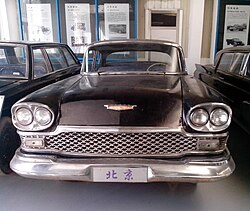
- Design: Bold Chinese characters reading “北京汽车” paired with industrial symbols
- Colors: Typical of the era’s state-owned industrial aesthetic
- Changes: Created specifically for the newly named Beijing Automobile Works
- Context: Reflected the brand’s position within national industrial development plans
2001–present: Modern Era
- Design: Simplified uppercase BAW lettering with strong geometric forms
- Colors: Often presented in red and black or blue and white schemes
- Changes: Updated during the BAIC subsidiary period and after the 2020 privatization
- Context: Signaled the company’s transition to a contemporary corporate structure focused on off-road vehicles and light trucks
The BAW logo evolution mirrors the company’s journey from its state-owned roots through multiple restructurings to its current status as a privately owned manufacturer. Each redesign has served to communicate the brand’s changing ownership and strategic direction while maintaining recognition.
Shandong Weiqiao’s 2023 acquisition positions the company for its next chapter. Although no new logo has been documented following this latest change, the BAW emblem continues to represent a legacy that spans more than six decades of Chinese automotive manufacturing. The modern BAW symbol balances historical industrial roots with contemporary design sensibilities appropriate for today’s market.