Key facts
- Founded
- 1948
- Founded by
- Raghunandan Saran
- Country
-
 India
- Headquarters
- Chennai, India
- Parent company
- Hinduja Group
- Legal name
- Ashok Leyland Limited
- Famous models
- AVTR, Boss, Dost, Bada Dost, Garud, Stallion
- Slogan
- “Koi Manzil Door Nahin”
- Website
- ashokleyland.com
In full, the Ashok Leyland logo is a round blue wheel of curved blades with an italic capital L in its hub, placed above or beside the name ASHOK LEYLAND. The wheel comes from Leyland, the British partner that gave the Indian company the second half of its name, and no redesign of it is documented.
Ashok Leyland Logo: What It Shows
The Ashok Leyland symbol is a flywheel. A solid blue disc is cut by curved white blades that spiral around a small round hub, and inside the hub sits a capital L in an italic serif face. On the company’s trucks and buses it appears as a chrome, three-dimensional badge.
The name ASHOK LEYLAND is set in capitals in a custom, wide sans-serif with rounded corners. The logo has two official layouts:
| Layout | Arrangement | Where it is used |
|---|---|---|
| Stacked | Flywheel centered above ASHOK LEYLAND | The main logo on this page; Wikipedia |
| Horizontal | Flywheel to the left of the name, tagline “Koi Manzil Door Nahin” below | The header of ashokleyland.com |
Each layout uses one color only, blue.
What Does the Ashok Leyland Logo Mean?
The Ashok Leyland logo stands for Leyland. The wheel with an L is the emblem of the British Leyland group, and the Indian company still uses the Leyland name and logo today. The L is the initial of Leyland. The first word of the name has a family origin: founder Raghunandan Saran named the company after his only son, Ashok.
We found no company statement that explains the blades. A flywheel is the heavy spinning wheel that keeps an engine turning smoothly, which suits a maker of engines and heavy vehicles, but that is a reading of the shape, not an official meaning.
Some logo sites describe the wheel as a camera shutter, as the Ashoka Chakra from India’s flag, or as two blades for two business divisions. None of these readings comes from Ashok Leyland, and the chakra on the flag is a wheel with 24 spokes, a different design.
Ashok Leyland Logo History
The Ashok Leyland logo history is short: the company has used one emblem, the Leyland flywheel, and no source records a redesign. Most older logos that logo sites file under Ashok Leyland actually belong to Leyland Motors in Britain.
1948: The Ashok Motors Name
The company started on 7 September 1948 as Ashok Motors in Madras, now Chennai. We found no clean artwork from those years; the only image is an archive photo that shows the name in plain capital letters.
Before the Flywheel: Leyland Motors in Britain
Leyland Motors, the British truck and bus maker behind the name, used other marks before the wheel: a brass oval maker’s plate and, in the 1960s, a script “Leyland” wordmark with a looped y. These are Leyland Motors (UK) logos. Ashok Leyland never used them as its own, so they are not shown here.
1968: British Leyland Flywheel (UK Precursor)
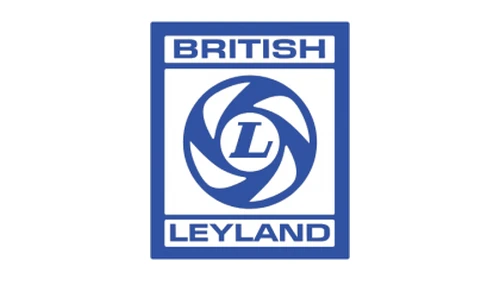
The flywheel comes from British Leyland, the UK group formed in 1968. Its emblem placed the same bladed wheel with an italic L inside a blue-bordered rectangle, with BRITISH above it and LEYLAND below.
Today: The Ashok Leyland Flywheel
The current Ashok Leyland logo keeps the wheel and drops the frame and the word British, so the flywheel stands alone in blue above the company name. When it was adopted is not documented. Several logo sites give 1986, but that is the year British Leyland was renamed Rover Group in Britain, and no Ashok Leyland source confirms it. The same sites list a “1986–2011” period, yet we found no logo change in 2011 or since.
The tagline “Koi Manzil Door Nahin” (“No destination is far”), launched in January 2023, came with a new advertising campaign, not a new emblem: the official website header still shows the flywheel.
Logos often filed under Ashok Leyland, and whose they really are:
| Logo shown on logo sites | Whose logo it is |
|---|---|
| Brass oval plate with the Leyland Motors name | Leyland Motors (UK) maker’s plate |
| Script “Leyland” wordmark | Leyland Motors (UK), 1960s |
| Flywheel in a rectangle with BRITISH and LEYLAND | British Leyland (UK), the source of the flywheel |
| Rosette badge | British Motor Corporation (BMC), not Leyland at all |
Ashok Leyland Logo PNG and Colors
The Ashok Leyland logo PNG at the top of this page is the stacked version: the flywheel above the name, in blue on a transparent background. It is drawn from the Wikipedia file and uses blue #016FB6. The company’s own header file uses a lighter blue, #0089CF.
The logo is a single color, with no gradient or second shade. A reversed version shows it in white on a blue field. For an Ashok Leyland logo in black and white, the one-color artwork converts directly, because there is no shading to lose.
Ashok Leyland Company Background
Raghunandan Saran, an independence campaigner from Punjab, founded Ashok Motors in 1948. Its first work was assembling British Austin A40 cars at Ennore, Chennai. In the early 1950s Ashok Motors teamed up with Leyland Motors to build Leyland vehicles under license, and the company took the name Ashok Leyland in 1955.
The collaboration with British Leyland ended in 1975, though technical help continued into the 1980s. In 1987 a joint venture of the Hinduja Group and Iveco took over the stake held by Land Rover Leyland International Holdings, and in 2007 the Hindujas bought out Iveco’s share. Ashok Leyland, based in Chennai, is now the flagship company of the Hinduja Group.
The range covers trucks, buses, light commercial vehicles, defence vehicles and engines, with model lines such as AVTR, Boss, Dost, Bada Dost, Garud and Stallion. In 2018 India Post issued a stamp sheet for the company’s 70th anniversary.
Frequently asked questions
What is the symbol of Ashok Leyland?
The symbol of Ashok Leyland is a blue flywheel: a round wheel of curved blades with an italic capital L in the middle. It sits above or next to the name ASHOK LEYLAND. On trucks and buses the same symbol is fitted as a chrome badge.
What does the Ashok Leyland logo symbolize?
It symbolizes the company's Leyland heritage. The flywheel with an L is the wheel mark of the British Leyland group, which Ashok Leyland kept using, and the L stands for Leyland. The company has not published an official meaning for the blades, so shutter or flag readings found online are guesses.
Is the Ashok Leyland logo the same as the Leyland logo?
The emblem is the same Leyland flywheel with an italic L. The difference is the setting: British Leyland framed it in a rectangle with the words BRITISH and LEYLAND, while Ashok Leyland shows the wheel on its own, in blue, with its full name in wide capitals.
Is Ashok Leyland an Indian brand?
Yes. Ashok Leyland is an Indian company, founded in Madras (now Chennai) in 1948 and still headquartered there. Only its name and logo point to Britain: they come from Leyland Motors, the British truck and bus maker that partnered with the company in its early years.
What was the original name of Ashok Leyland?
The original name was Ashok Motors. Raghunandan Saran founded the company on 7 September 1948 and named it after his son Ashok. After the partnership with Britain's Leyland Motors in the early 1950s, the company became Ashok Leyland in 1955.
What is the tagline of Ashok Leyland?
The current tagline is "Koi Manzil Door Nahin," meaning "No destination is far." Ashok Leyland launched it in January 2023 with a new advertising campaign. On the official website it appears under the horizontal version of the logo; the flywheel emblem itself did not change.
Who owns Ashok Leyland?
The Hinduja Group owns Ashok Leyland, which is the group's flagship company. The Hindujas took control in 1987 through a joint venture with Iveco and became sole owners of that holding in 2007, when they bought out Iveco's share.
Why does Ashok Leyland not make cars?
Ashok Leyland is a commercial vehicle maker. It began in 1948 by assembling Austin A40 cars, but after its tie-up with Leyland Motors it built trucks and buses. Today it makes trucks, buses, light commercial vehicles such as the Dost, defence vehicles and engines.