Key facts
- Years active
- 1905–1991
- Founded by
- Karl Gustav Hiller
- Country
-
 Germany
- Headquarters
- Zittau, Germany
- Famous models
- Robur LO 3000, Robur LO 2500, Robur LO 1801 A, Robur LO 1800 A
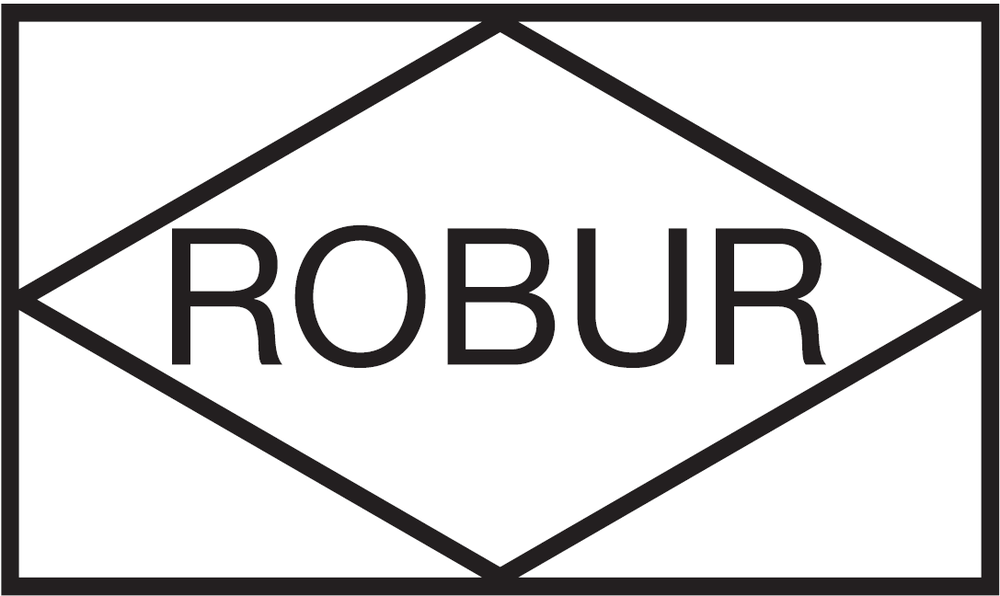
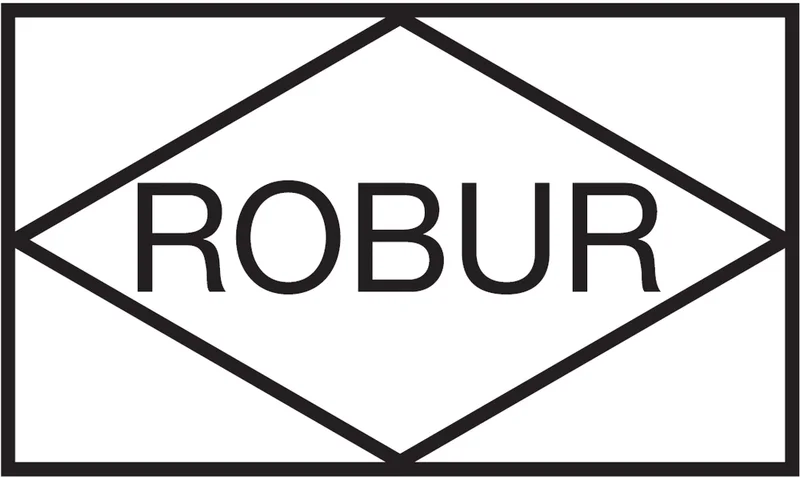
The Robur logo is the name ROBUR in black capitals inside a wide diamond frame. Robur was the truck marque of the East German state firm VEB Robur-Werke Zittau, which built mainly 3-ton trucks in Zittau, Saxony.
Robur Logo
The Robur symbol is a simple black and white design. A wide diamond with points to the left and right is drawn in a heavy black outline on a white background, and the word ROBUR fills the middle in plain capital letters. The Robur emblem has no colours, no picture and no extra lettering, so the name does all the work.
The Robur badge belongs to the LO and LD series trucks, and the Robur truck logo is the mark of the whole marque. The page offers the Robur logo PNG with a transparent background, so the black outline works on a light background without a white box.
What the Robur logo means
Two sources explain the Robur logo meaning. The name Robur stems from the Latin name of the pedunculate oak, Quercus robur, and the logo design was inspired by a crankshaft.
Robur Logo History
Robur logo history begins with the name itself. In 1957 the heirs of Gustav Hiller took control of the company and renamed it VEB Robur Werke Zittau, after the trucks had been sold under the name Phänomen. The diamond mark with the ROBUR lettering is the original Robur logo and the one the marque kept until production ended in 1991.
Robur History
In 1888 Karl Gustav Hiller founded a company in Zittau to distribute a pom-pon machine that he had invented. He later took over the Zittau machine factory and began to sell Rover Safety Bicycles under the name Phänomen-Rover. The company built Phänomen motorcycles from 1900, and in 1905 it began the mass production of the three-wheeled Phänomobil. It added four-wheeled cars between 1912 and 1927, and trucks such as the Granit 25 and Granit 30 in 1931 and 1936.
After the war the Phänomen works became a state-owned Volkseigener Betrieb in 1946, and it made the Granit 27 and the Garant, of which around 50,000 were built as buses, trucks and ambulances until 1961. In 1957 it took the Robur name. The Robur LO 2500 was shown at the Leipzig Trade Fair in 1961, and the 3-ton LO 3000 followed in 1974, with diesel engines offered from 1982. The four-wheel-drive variants were the LO 1800 A and LO 1801 A.
Robur trucks were used in the COMECON area and in several overseas countries, through the Robur-Safari program that adapted trucks to the climate of each market. After German reunification the company quickly folded, and production was cancelled in 1991. Successor firms were founded in 1995 and 1999, and one of them builds and supplies components for vehicles.
Robur Logo PNG and Colors
The download button at the top of this page saves the last Robur logo as a PNG file, 1000 × 596 pixels.
| Colors | Black |
|---|---|
| File | PNG, 1000 × 596 px |
Frequently asked questions
Who founded Robur?
Robur was founded in 1905 by Karl Gustav Hiller.
What does the Robur logo mean?
The Robur logo design was inspired by a crankshaft, and the name Robur comes from the Latin name of the pedunculate oak, Quercus robur.
What does the name Robur mean?
Robur stems from the Latin name of the pedunculate oak, Quercus robur. The heirs of Gustav Hiller chose it in 1957 when the company was renamed VEB Robur Werke Zittau.
What country is Robur from?
Robur was a German truck brand, based in Zittau, Germany.
Does Robur still exist?
No. Robur was active from 1905 to 1991.
What color is the Robur logo?
The last Robur logo is black.
What vehicles did Robur make?
The best-known Robur models were the Robur LO 3000, Robur LO 2500, Robur LO 1801 A and Robur LO 1800 A.