Key facts
- Founded
- 1993
- Founded by
- UMW Holdings, Daihatsu Motor Co., MBM Resources, PNB Equity Resource Corporation
- Country
-
 Malaysia
- Headquarters
- Rawang, Malaysia
- Legal name
- Perusahaan Otomobil Kedua Sendirian Berhad
- Famous models
- Myvi, Axia, Bezza, Alza, Ativa
- Slogan
- “Building Cars, People First”
- Website
- www.perodua.com.my
The Perodua logo is a glossy ellipse that holds a green letter P and a red number 2, with the name PERODUA in black capitals underneath. Perodua is Malaysia’s largest car manufacturer, known for small, affordable cars.
Perodua Logo
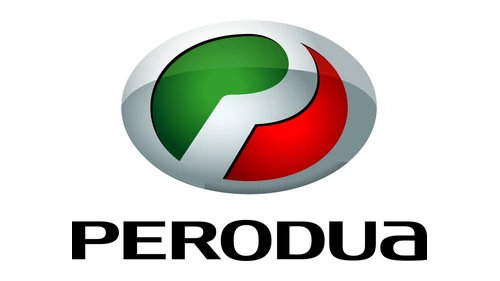
The emblem is built from two shapes inside an oval: a green P on the left and a red 2 on the right, separated by a silver-grey curve. The Perodua emblem has a metallic, three-dimensional finish, and the black PERODUA wordmark below it is set in wide, rounded capitals. On the current design the colours are bright and the oval has a silver rim, which gives the Perodua symbol the look of a polished badge. On cars, the Perodua car logo appears as a Perodua badge on the grille, for example on the Aruz.
This page offers the Perodua logo PNG with a transparent background, so the green and red emblem can be placed on any layout. If you only need a quick Perodua PNG for a document, the oval can also be used without the wordmark.
What the Perodua logo means
The Perodua logo meaning is spelled out in the name of the company. Perodua is short for Perusahaan Otomobil Kedua, which means “Second Automobile Company”, and the emblem shows a P and a 2: the first letter of the name and the number two. The green and red colour blocks have been carried from version to version since the first, square design. The oval gives the P and the 2 a single shape and suggests movement.
Perodua Logo History
The Perodua logo evolution covers three versions, and all of them keep the P and 2 and the same pair of colours. What changes from one to the next is the shape, the finish and the lettering.
The first badge was used from 1993 to 1998. It is a squarish badge of a green block and a red block divided by a white P-shaped line, set beside a slanted black wordmark with a striped O and the Malay slogan “Kehebatan yang pasti”, which means “Absolute greatness”.
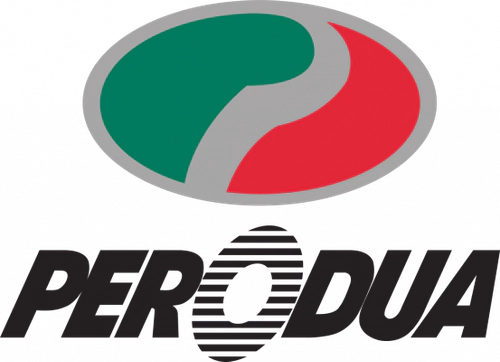
In 1997 Perodua held a competition to find a new corporate logo, to be launched with its upcoming model. The winner was Johnson Ng Weng Kuan, an architecture student at Universiti Teknologi Malaysia. The company unveiled the new logo on 24 August 1998, when it launched Malaysia’s first sport utility vehicle, the Perodua Kembara. The old Perodua logo had been square, and the new one stylised it further into an ellipse, with the slanted striped-O wordmark placed under the oval.
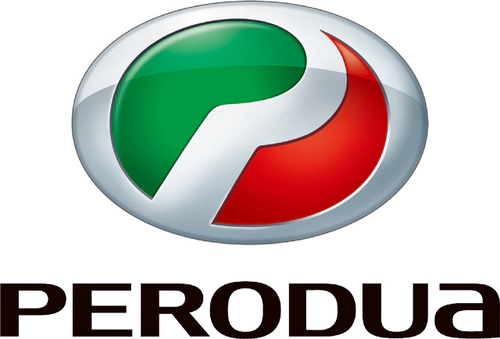
In June 2008 Perodua launched a new corporate identity, and the logo was updated with it. The new Perodua logo keeps the P, the 2 and the main colour blocks of the earlier logos but brightens the colours and adds a metallic look and a three-dimensional effect. The slanted wordmark was replaced by a plain, upright black one, and this design is still in use.
Perodua History
The full legal name, Perusahaan Otomobil Kedua Sendirian Berhad, means “Second Automobile Company Private Limited” in Malay, and the company is usually called by the short form, Perodua. It was established in 1993 and launched its first five-door hatchback, the Kancil, in August 1994. It first produced mainly minicars and superminis and did not have models in the same market segments as Proton, the other Malaysian manufacturer, but their segments later began to overlap, especially in the super-compact class, where the Perodua Myvi has competed with the Proton Savvy and the Proton Iriz.
Perodua does not design or engineer its main components, such as engines and transmissions, in-house, and its cars have historically used Daihatsu component designs. Daihatsu held a 20% stake at the company’s launch, raised it to 25% in 2001 and then to 35%. In 2004 Perodua began assembling the Toyota Avanza at its plant in Rawang for sale in Malaysia. The shareholders are UMW Holdings (38%), Daihatsu Motor Co. (20%), Daihatsu (Malaysia) (5%), MBM Resources (20%), PNB Equity Resource Corporation (10%), Mitsui & Co. (4.2%) and Mitsui & Co. (Asia Pacific) (2.8%). Perodua is Malaysia’s largest car manufacturer, followed by Proton Holdings. Models named in the company’s range include the Kancil, Myvi, Axia, Bezza, Alza and Ativa, and the Kembara sport utility vehicle.
Perodua Logo PNG and Colors
The current Perodua logo file on this page is a PNG image of 1728 × 1214 pixels, the design in use since 2008. Older versions from the history above open in the logo switcher under the main image.
| Colors | Red, Green |
|---|---|
| Shapes and motifs | Circles |
| Logo versions | 3, since 1993 |
| Current logo | Since 2008 |
| File | PNG, 1728 × 1214 px |
Frequently asked questions
Who founded Perodua?
Perodua was founded in 1993 by UMW Holdings, Daihatsu Motor Co., MBM Resources and PNB Equity Resource Corporation.
What does the Perodua logo mean?
The Perodua logo shows a P and a 2, from Perusahaan Otomobil Kedua, or "Second Automobile Company". The P and 2 and their colour blocks have been kept in every version since the square 1993 logo.
What does the name Perodua mean?
Perodua is short for Perusahaan Otomobil Kedua, which means "Second Automobile Company" in Malay.
What country is Perodua from?
Perodua is a Malaysian car brand, headquartered in Rawang, Malaysia.
Did Perodua change its logo?
Yes. Perodua has used three logos since 1993. In order: Square P and 2 with slogan (1993–1998), Elliptical P and 2 emblem (1998–2008) and Metallic 3D emblem (2008–present). The current logo dates from 2008.
What color is the Perodua logo?
The current Perodua logo is red and green and features a circle.
What is the Perodua slogan?
The Perodua slogan is "Building Cars, People First".
What cars does Perodua make?
Well-known Perodua models include the Myvi, Axia, Bezza, Alza and Ativa.
Is Perodua a Toyota brand?
No. Perodua is a Malaysian car maker. Its shareholders include UMW Holdings, Daihatsu Motor Co., MBM Resources and PNB Equity Resource Corporation, and since 2004 it has also assembled the Toyota Avanza at its plant in Rawang for the Malaysian market.