Key facts
- Founded
- 1947
- Founded by
- Ernesto Maserati, Ettore Maserati, Bindo Maserati
- Country
- Italy
- Headquarters
- Macchia d'Isernia, Italy
- Parent company
- DR Automobiles
- Legal name
- Officine Specializzate Costruzione Automobili – Fratelli Maserati S.p.A.
- Famous models
- MT4, 1600 GT, FS372, MT6
Brand History and Milestones
O.S.C.A. was established in Bologna by Ettore Maserati, Ernesto Maserati, and Bindo Maserati. The three brothers formed the company after their contract with Adolfo Orsi ended. Headquartered in San Lazzaro di Savena, the firm focused on racing and sports cars.
Key events shaped its relatively short existence. In 1947 the company began operations with its first logo design. Late 1949 brought an important logo update once contractual restrictions with Orsi expired. The 1950s represented the peak racing success period, highlighted by the 1954 12 Hours of Sebring victory. Count Domenico Agusta, owner of MV Agusta, purchased the company in 1963. Operations continued under new ownership until all activities ceased in 1967.
Osca Logo Evolution
1947–1949: Early Logo
The first emblem reflected the engineering focus of the newly founded company. It appeared on early MT4 chassis numbered 1101 through 1110.
- Design: Circular badge with thick black outline and light-cream inner field
- Colors: Blue, white, and red drawn from the Bologna Coat of Arms plus black
- Changes: Featured a mechanical gear sprocket at center; deliberately omitted the Maserati name due to sales contract restrictions
- Context: Used during the founding and initial racing period
1949–1965: Main Logo
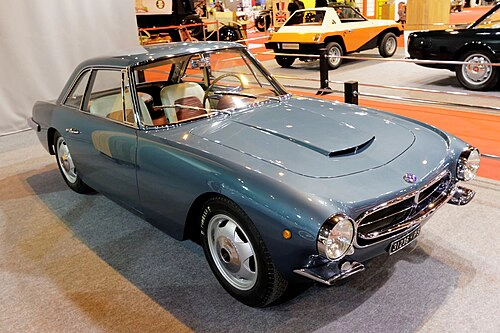
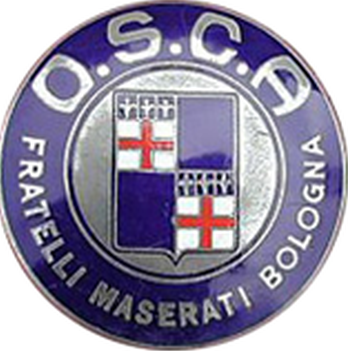
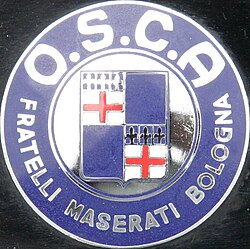
This version became the most recognized Osca emblem. It incorporated the family name once contractual limitations eased, allowing the brothers to leverage their prestige while expressing pride in their Bologna origin. Osca logo history is clearly visible in the transition from the first to this second design.
- Design: Circular format with bold extended sans-serif typography for O.S.C.A. and narrower typeface for smaller text
- Colors: Dark royal blue, Bologna red, white, and silver
- Changes: Added Maserati name to outer ring; replaced gear sprocket with heraldic focus
- Context: Primary emblem on all products throughout the classic period
1960–1965: Final Variant
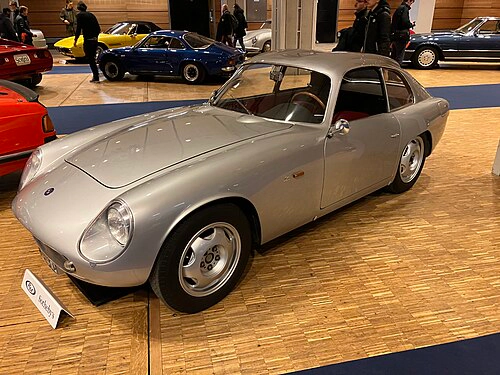
A refined version appeared mainly inside vehicles during the later GT series years. This Osca car logo received subtle adjustments while keeping the core circular structure and city symbolism.
- Design: Same circular form but with rearranged text hierarchy
- Colors: Retained blue, red, white, and silver palette
- Changes: Promoted Maserati name to top position; altered text directions and switched background to silver
- Context: Primarily used on gauges, steering wheels, and some official letterhead from 1961 in 1600GT, GTV, and GTS models
Logo Design Elements and Symbolism
The Osca emblem maintained a consistent circular form across all eras, reflecting an engineer’s practical attitude without pretension. At its center the Bologna Coat of Arms symbolized the brothers’ strong local pride after returning to the city. Blue conveyed stability and reliability while silver added technical elegance and red brought energy plus Bologna heritage.
Typography played an important role. The Osca symbol used bold, extended sans-serif lettering for the main acronym with a narrower simpler typeface for supporting text. The font family traces to Gallico (Serie Mercurio, 1903). Visual hierarchy kept the brand name largest, placed the Maserati name secondarily, and rendered Fratelli and Bologna smallest yet symbolically meaningful.
The persistent use of Bologna’s coat of arms across every Osca badge demonstrated deep connection to the city of origin. Direct links exist between company events and visual changes. Founding in 1947 produced the initial logo without the Maserati name. Contractual easing in late 1949 enabled its addition. Racing success encouraged replacement of the mechanical sprocket with more heraldic themes. The shift toward GT models in the 1960s prompted the final variant that emphasized the family name more prominently.
Legacy
O.S.C.A. left a mark as a boutique Italian manufacturer focused on performance rather than volume. Its cars embodied the Maserati brothers’ engineering vision after they departed the original company. The brand’s logos continue to fascinate enthusiasts who study automotive branding history.
Today collectors and historians reference the various emblems when documenting the company’s story. The Osca logo evolution illustrates how contractual realities, family pride, and shifting product focus can influence visual identity. From the mechanical sprocket of the earliest period to the refined final variant, each Osca car symbol tells part of the broader narrative of this respected Italian marque that operated between 1947 and 1967.