Key facts
- Years active
- 1988–2012
- Country
- China
- Headquarters
- Baoding, Hebei, China
- Parent company
- CHTC
- Legal name
- Dadi Automobile Group Co., Ltd.
- Famous models
- Shuttle, Smoothing, Unisonous
Dadi Brand Overview
Dadi Auto grew out of a Chinese military repair unit. Before 1988 the People’s Liberation Army ran a vehicle-refitting company in Baoding, Hebei, that maintained and modified army trucks. That year the operation was spun off as a civilian business, the Baoding Dadi Automobile Refitting Factory, and it assembled its first civilian pickup the same year.
The brand’s biggest early moment came in 1990, when Dadi supplied open-top ceremonial cars used at the 11th Asian Games in Beijing; one carried the Games’ giant panda mascot past the crowd during the opening ceremony at Workers’ Stadium. Through the early 1990s Dadi built station wagons and sedans, known internally by their BDG model codes, before production slowed for several years in the middle of the decade.
The company was reorganized in 1999 as Baoding Dadi Automobile Industry Co., Ltd., and it returned to volume production in the early 2000s with a new line of SUVs and pickup trucks carrying BDD model codes. Many of these were built on licensed or donor platforms from Japanese automakers: the Dadi Bliss pickup used Isuzu Rodeo running gear, the Dadi Unisonous pickup was based on the Isuzu D-Max, the City Leading and City Steed SUVs were built on older Toyota Land Cruiser platforms, and the Dadi Shuttle, launched in 2007 as the brand’s last new SUV, copied the styling of the newer Land Cruiser Prado.
By 2011 Dadi was struggling, and the Chinese state-owned conglomerate China Hi-Tech Group Corporation (CHTC) acquired the company that November. On 16 October 2012 Dadi Auto was formally dissolved and reincorporated as Hengtian (CHTC) Dadi Automobile Co., Ltd., ending the Dadi brand as an independent car maker after 24 years. The Hengtian successor continued to build commercial and off-road vehicles at the same Baoding plant.
Dadi Logo Meaning
Dadi’s badge in its final years was a circular emblem divided by a raised, tapering cross into five pie-shaped segments, evoking the spokes of a steering wheel. Some accounts of the design also read the negative space at the center as an echo of da (大), the first character of the brand’s Chinese name, Dadi (大迪). The DADI wordmark, in a plain bold sans-serif, sat directly beneath the circle. Like many Chinese carmakers of the period, Dadi treated the emblem as a rendering in flat black or grey rather than as a fixed brand colour.
Dadi Logo History and Evolution
Documentation of Dadi’s badges is thin, but photographs of surviving vehicles show that the brand changed its logo more than once as the company was repeatedly restructured, and that different logos sometimes appeared on cars of the same model year.
1988–1990s: Chinese Characters on the Grille and Tailgate
Dadi’s earliest vehicles, the BDG-series wagons and sedans, carried the brand name written out in Chinese characters, 大迪, on the grille or between the taillights, rather than a pictorial emblem. The 1990 Asian Games parade cars were a special case: their bull bars carried an “A”-shaped badge tied to the Games itself rather than Dadi’s own branding.
Early-to-mid 2000s: Corporate Badge Redesigns
As Dadi restructured and relaunched its SUV and pickup lineup in the 2000s, it introduced at least two further logo revisions, one dated to around 2003 and another to around 2007, alongside changes to the lettering used for the DADI wordmark. No reliable image of either intermediate design survives in the sources available for this article.
2007–2012: The Steering Wheel Emblem
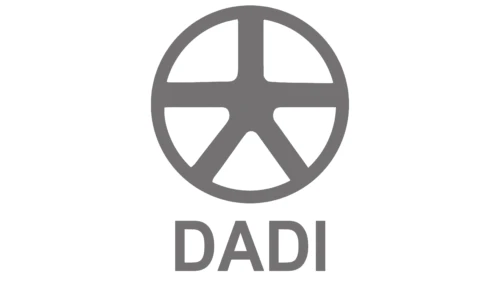
By the time of the Shuttle, City Leading and City Steed SUVs, Dadi vehicles wore the circular, wheel-like emblem shown above, paired with the DADI wordmark. This was the version of the logo in use when CHTC acquired the company in 2011, and it disappeared along with the Dadi name after the 2012 reorganization into Hengtian (CHTC) Dadi.
What Happened to Dadi Auto?
Dadi Auto no longer exists as an independent brand. CHTC’s 2011 acquisition and the October 2012 renaming folded Dadi’s factory, workforce and vehicle programs into Hengtian (CHTC) Dadi Automobile Co., Ltd., which kept building pickups and specialty commercial vehicles at the Baoding site under the new name. Dadi-badged cars are now uncommon on Chinese roads and are mostly of interest to collectors of obscure domestic marques.
FAQ
When was Dadi founded?
Dadi traces back to 1988, when a former People’s Liberation Army vehicle-refitting company in Baoding, Hebei, was spun off as a civilian automaker and built its first pickup truck.
Who owns Dadi now?
Dadi has no current owner as an active brand. China Hi-Tech Group Corporation (CHTC) bought the company in November 2011 and dissolved it in October 2012, folding its operations into Hengtian (CHTC) Dadi Automobile Co., Ltd.
What does the Dadi logo mean?
Dadi’s last badge was a circle split into five wheel-like spokes by a raised cross shape, meant to suggest a steering wheel, sitting above a plain DADI wordmark.
What happened to Dadi Auto?
Dadi struggled through the 2000s despite launching newer models like the Shuttle SUV. CHTC acquired the company in 2011 and officially dissolved it on 16 October 2012, ending 24 years of the Dadi name.
What cars did Dadi make?
Dadi built station wagons and sedans in the early 1990s, then shifted to pickups and SUVs in the 2000s, including the Bliss and Unisonous pickups and the City Leading, City Steed and Shuttle SUVs, several of them based on Isuzu and Toyota platforms.