Key facts
- Years active
- 1963–1995
- Founded by
- Luiz Roberto Alves da Costa, Milton Masteguin, Mário César de Camargo Filho, Rino Malzoni
- Country
-
 Brazil
- Headquarters
- Botucatu, Brazil
- Legal name
- Puma Automóveis Ltda.
- Famous models
- GT Malzoni, Puma GT, GTE, GTS, GTB, P-018
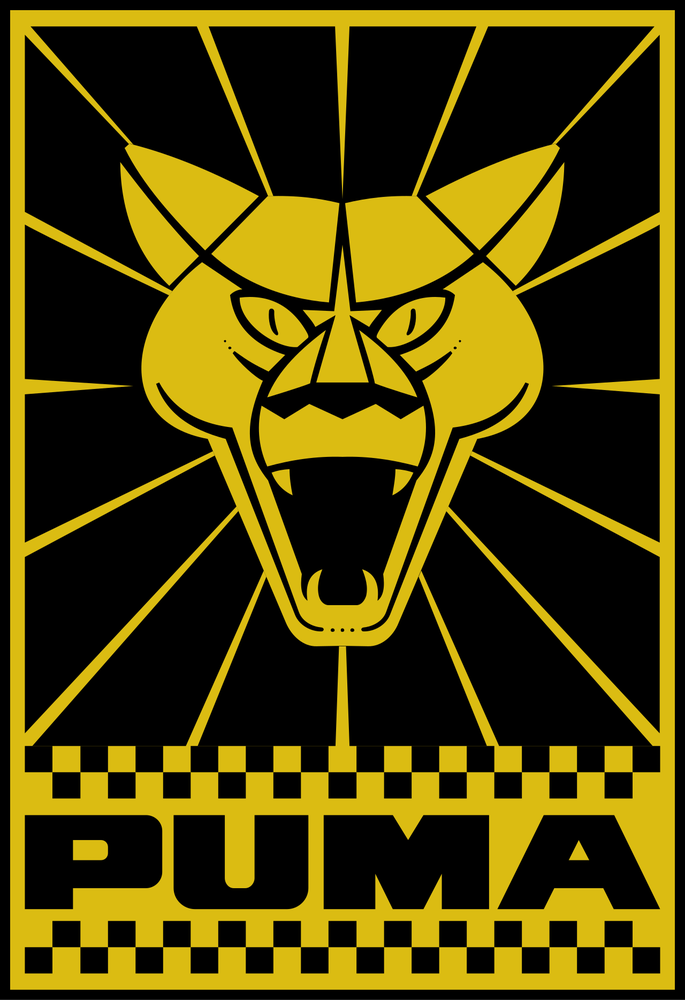
The Puma logo is a tall black rectangle with a yellow border and a roaring yellow puma head inside it. Puma was a Brazilian maker of fiberglass-bodied sports cars from the state of São Paulo.
Puma Logo
The Puma emblem is drawn in only two colours, black and yellow. The puma head with its open mouth sits in the upper part of the rectangle, and thin yellow rays spread out behind it. Below the head runs a yellow chequered strip, and the name PUMA is set in bold yellow capitals along the bottom. The strip and the rays give the badge a racing look that suits a sports car.
The rectangle works as the Puma badge, the Puma symbol of the marque and the Puma car logo for every model. The page offers the Puma logo PNG with a transparent background.
Puma Logo History
The Puma logo history is a single design, the black and yellow rectangle with the puma head. It was the emblem of the marque from around 1964 until 1995.
Puma History
Puma began with Rino Malzoni, an Italian-born Brazilian designer who wanted a sporty fiberglass body on a production car chassis, with the engine and suspension tuned for more performance. He built a prototype racing car on his farm in Matão, in the interior of São Paulo, with an engine and rolling chassis from Vemag, the Brazilian DKW representative.
The prototype won five races at Interlagos in 1964, and the company followed: Sociedade de Automóveis Lumimari was founded by Luiz Roberto Alves da Costa, Milton Masteguin, Mário César de Camargo Filho and Rino Malzoni. Each founder gave the first two letters of his first name to the company name, which spells Lumimari. The name Puma was suggested by Jorge Lettry, head of the competition department at Vemag.
The first model was the GT Malzoni, followed by the Puma GT, which used the Karmann Ghia 1500 platform from 1968 once Volkswagen had bought DKW. Later models include the GTE, the Spider that became the GTS, the GTB on the Chevrolet Opala platform and the P-018 of 1980.
Financial difficulties led Puma to lease its brands and molds to Araucária Veículos in 1986, and in 1988 production moved to Alfa Metais, which built the AM1 to AM4 and the AMV. Cars under the Puma name were sold until 1995. Puma Automóveis Ltda was created in 2013 to continue the brand, and it presented the Puma P-052 motorsport prototype and the Puma GT Lumimari.
Puma Logo PNG and Colors
The download button at the top of this page saves the last Puma logo as a PNG file, 685 × 1000 pixels.
| Colors | Yellow, Black |
|---|---|
| Shapes and motifs | Animals |
| Logo versions | One, since 1964 |
| File | PNG, 685 × 1000 px |
Frequently asked questions
Who founded Puma?
Puma was founded in 1963 by Luiz Roberto Alves da Costa, Milton Masteguin, Mário César de Camargo Filho and Rino Malzoni.
What country is Puma from?
Puma was a Brazilian car brand, based in Botucatu, Brazil.
Does Puma still exist?
No. Puma was active from 1963 to 1995.
Did Puma change its logo?
No. Puma used one logo: Black and yellow rectangle with puma head (1964–1995).
What color is the Puma logo?
The last Puma logo is yellow and black.
What cars did Puma make?
The best-known Puma models were the GT Malzoni, Puma GT, GTE, GTS and GTB.
What does Lumimari mean?
Lumimari was the original name of the company, Sociedade de Automóveis Lumimari. It joins the first two letters of the first names of the founders: Luiz Roberto Alves da Costa, Milton Masteguin, Mário César de Camargo Filho and Rino Malzoni.