Key facts
- Founded
- 1909
- Founded by
- Wilhelm Maybach (with Karl Maybach)
- Country
-
 Germany
- Headquarters
- Stuttgart, Germany
- Parent company
- Mercedes-Benz Group
- Famous models
- 57, 62, S-Class, GLS, EQS SUV, SL
- Slogan
- “Create the very best from the very best”
Maybach Logo Meaning: What the Double M Symbol Stands For
The two Ms stand for Maybach Motorenbau, roughly “Maybach engine building” in German, which was the name of the company behind the brand. The monogram has stayed the same since the cars of the 1920s, while its colors and frame have changed.
What you see in the Maybach symbol:
- Two Ms: one tall and narrow, one wide and low, set on top of each other.
- The triangle: a shield shape with curved sides and soft corners.
- The colors: green on golden orange at first, black on golden orange from 2002, plain chrome on today’s cars.
- The name: MAYBACH runs along the bottom edge of the original emblem only. Later versions leave it out.
We found no Maybach or Mercedes-Benz source that explains the shape or the colors, and no designer is on record. Logo sites often read the triangle as stability and the gold as prestige, and some posts claim the three corners stand for land, air and water. None of this comes from the brand. Whatever the reading, the Maybach sign is simply the company’s initials.
Maybach Logo History and Evolution
The Maybach logo has had four versions: three forms of the double-M emblem and a plain MAYBACH wordmark. The monogram never changed. The colors, the frame and the lettering around it did.
Many logo sites say the first emblem was created in 1909 and used unchanged until 1997. Neither date is well supported. In 1909 the company was not yet called Maybach-Motorenbau, and no Maybach cars were built between 1940 and 2002.
| Period | Colors | Wordmark | What changed |
|---|---|---|---|
| 1920s–1940 | Green on golden orange, white border | MAYBACH under the monogram | First version, used in the car era |
| 2002–2012 | Black on golden orange | None | Black replaces green and white, 3D look |
| 2015–present | Chrome or silver | Separate, on the trunk lid | Metal badge on the rear pillars |
| c. 2015–present | Black on white | MAYBACH on its own | Name only, no monogram |
1920s–1940: The Original Maybach Logo
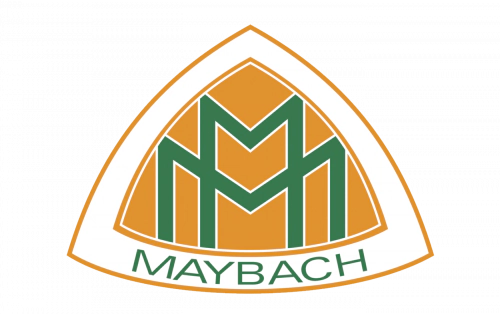
This is the old Maybach logo most people picture. A thin orange outline surrounds a wide white band, the center is golden orange, and both the Ms and the MAYBACH name below them are green.
It belongs to the Maybach-Motorenbau years. No source gives an exact adoption date, but the emblem appeared on the company’s cars. Those ran from the W3, shown at the Berlin Motor Show in September 1921, to the last car built in 1940.
2002–2012: The Black-and-Gold Emblem of the Revival
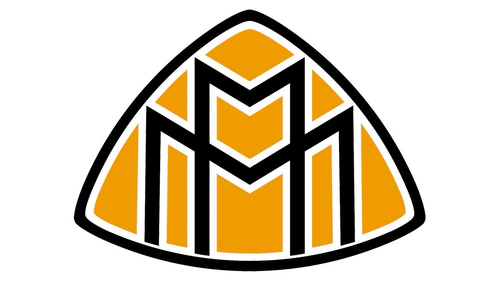
Daimler brought the name back after it presented a luxury concept car at the Tokyo Motor Show in 1997. The emblem returned in a new form, reportedly dating from 1997 and fitted to production cars from 2002. The green letters and the white border turned black, the name was dropped, and the badge took on a beveled, three-dimensional look. The shield and the golden-orange field stayed. On the cars themselves the badge was made in silver-toned metal.
This was the logo of the Maybach 57 and 62, named for their body lengths of 5.7 and 6.2 meters. The 62 was presented in New York on July 2, 2002. The last car of this generation was built on December 17, 2012.
2015–Present: The New Mercedes-Maybach Emblem
Daimler announced the comeback in November 2014, this time as a sub-brand for the most luxurious S-Class, and the first model went on sale in 2015. The new Maybach logo keeps the double M inside an arched triangle but drops the colored fill: it is chrome or silver.
Its main place is the rear roof pillar, and on the S-Class these pillar emblems light up. We found no Mercedes-Benz description of the redesign, so these details come from its model pages and parts catalogs.
c. 2015–Present: The MAYBACH Wordmark
The fourth version is the name alone: MAYBACH in wide-set black capitals, with stretched round letters, thin horizontal strokes and no monogram or triangle. It is the logo at the top of this page.
Mercedes-Maybach cars spell the name in capitals on the trunk lid. We could not find a source that dates this wordmark, so the 2015 start is an estimate tied to the relaunch.
Maybach Logo Colors and Font
The background of the original emblem is described as gold by some logo sites and orange by others. In the original artwork shown above it is a golden orange, and the revival emblem kept that shade under its black letters. Green appears only on the first version.
No typeface is documented for Maybach. The wordmark uses wide, uppercase sans-serif letters, and one logo site describes the monogram as hand-drawn rather than set in a font. Font-matching sites suggest lookalike typefaces, but none of them is the brand’s own.
If you need a black and white Maybach logo, the wordmark is already black on white. Use the download button at the top of the page to save it as a PNG.
Mercedes-Maybach Logo vs the Mercedes Star
A Mercedes-Maybach wears two logos because it is two brands at once. Since 2015 Maybach has been a sub-brand of Mercedes-Benz, placed above the regular models in the way Mercedes-AMG sits above them for performance. At its launch it was aimed at the Rolls-Royce Phantom and the Bentley Mulsanne.
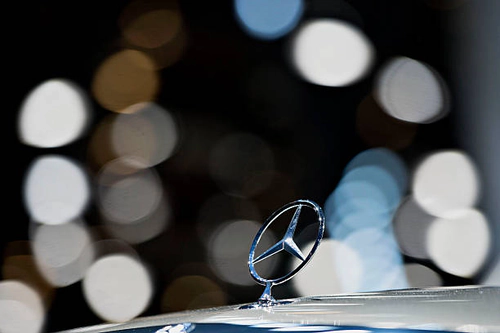
The three-pointed star stays as the maker’s mark on the hood, the steering wheel and the tail. The Mercedes-Maybach logo, the double M, marks the luxury line. That is why a photo of a Maybach hood usually shows the star and not the monogram.
Maybach Emblem and Badges on the Car
To spot the logo on cars built since 2015, start with the rear pillars, where it is easiest to find. Where to look:
- Rear pillars: a pair of chrome double-M badges, illuminated on the S-Class.
- Trunk lid: the MAYBACH name in capitals.
- Hood: the Mercedes star on today’s cars. The 57 and 62 had a triangular Maybach hood ornament, and on the Zeppelin version the word ZEPPELIN was worked into it.
- Special editions: the SL 680 Monogram Series is the first two-seater to carry the Maybach signet.
Replacement badges are Mercedes-Benz parts. One parts dealer lists the rear-pillar Maybach badge pair for the current S-Class (W223, V223 and Z223) as A2238172700 and A2238170300. Check those numbers against Mercedes-Benz’s own catalog.
Not every Maybach logo you see comes from Mercedes. Eyewear and bags sold as MAYBACH – Icons of Luxury come from a family-owned licensing company, not from the carmaker.
Maybach Meaning: Where the Name Comes From
Maybach is a family name. The brand is named after Wilhelm Maybach (1846–1929), the engineer who was technical director of Daimler-Motoren-Gesellschaft until 1907 and developed the first Mercedes in 1900.
Wilhelm Maybach founded the company on March 23, 1909, with his son Karl (1879–1960) as director, as a subsidiary of Count Zeppelin’s Luftschiffbau Zeppelin. Its first name was Luftfahrzeug-Motorenbau GmbH, roughly “aircraft engine company”. It started in Bissingen an der Enz and moved to Friedrichshafen on Lake Constance around 1911–1912.
The firm was later renamed Maybach-Motorenbau GmbH. German sources date the change to 1918, while some English sources say 1912. That second name is the one the double M spells out.
Frequently asked questions
What car has the MM logo?
Maybach. Its emblem is a double M inside a triangle with rounded corners, the initials of Maybach Motorenbau, the engine company behind the brand. Today it is mostly seen as a chrome badge on the rear roof pillars of Mercedes-Maybach cars.
Is a Maybach just a Mercedes?
Today, largely yes. Every current Maybach is a Mercedes-Benz model, such as the S-Class, GLS, EQS SUV or SL, built to a higher level of luxury and sold as Mercedes-Maybach. The 57 and 62 of 2002 to 2012 were different: Daimler sold them as their own brand.
What was Maybach before Mercedes?
It was a German engine maker that also built luxury cars. Its engines powered German aircraft and airships in World War I, its cars were made from 1921 to 1940, and in World War II its engines drove most German tanks and half-tracks, including the Tiger. Daimler-Benz bought the company in 1960, and by 1969 it had become MTU Friedrichshafen.