Key facts
- Years active
- 1871–1984
- Founded by
- Georg Egestorff
- Country
- Germany
- Headquarters
- Hanover, Germany
- Legal name
- Hannoversche Maschinenbau Actien-Gesellschaft
- Famous models
- Kommissbrot, Rekord, Sturm, Garant
Hanomag Brand History
Hanomag’s predecessor company was founded in 1835 by Georg Egestorff in Linden near Hanover, Germany, as Eisen-Giesserey und Maschinenfabrik Georg Egestorff. The company built its first railway locomotive in 1846 and underwent major restructuring in 1871 when it was renamed Hannoversche Maschinenbau Actien-Gesellschaft. This renaming established the official Hanomag identity that would appear on all future products.
From its early focus on steam engines and farm machinery, Hanomag expanded into road vehicles with steam wagons for the German army in 1905. It began production of motorized ploughs in 1912. The company entered the farm tractor market in 1924 with the Hanomag WD/R26 and launched its first passenger car in 1925, the Hanomag 2/10 PS known as Kommissbrot. Financial crises led to restructuring between 1928 and 1931, after which it operated as Hanomag Automobil und Schlepperbau GmbH.
Hanomag started construction machinery production in 1931. It joined the Rheinstahl consortium in 1952, merged with Henschel-Werke in 1964, and later sold its tractor division to Massey Ferguson and truck division to Daimler-Benz in 1969. Komatsu acquired a majority stake in 1989 and achieved full ownership in 2002, making it Komatsu Hanomag GmbH. The original branches had ceased operations between 1984 and 2002.
Hanomag Logo Evolution
Pre-1920s: Steam and Locomotive Era
The early period used emblems connected to the full company name Hannoversche Maschinenbau Actien-Gesellschaft. These designs appeared during the steam locomotive era that began with the first railway locomotive in 1846. The 1871 renaming created the foundation for the shorter Hanomag name used in later branding.
- Design: Early company emblems tied to full corporate name
- Colors: Primarily black and white
- Changes: 1871 renaming established the Hanomag identity for future use
- Context: Steam era focused on locomotives and small steam engines
1920s-1930s: Tractor and Car Launch Period
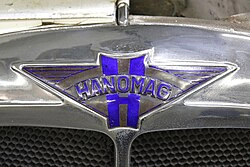
This era saw the launch of the first farm tractor in 1924 and the Kommissbrot car in 1925. These new product lines created demand for clear, visible brand emblems on both agricultural equipment and passenger vehicles. The distinctive Hanomag wordmark appeared on radiator badges and tractor hoods during this peak period of automotive and tractor production.
- Design: Bold sans-serif wordmark used as radiator badges and tractor emblems
- Colors: Metallic chrome on badges with occasional red accents
- Changes: Logo updates tied to new product categories
- Context: Hanomag logo history begins with high visibility on 1925 Kommissbrot and 1924 tractors
1950s-1960s: Post-War Machinery Era

Hanomag continued using crest and badge designs on its post-war tractors and trucks. Evidence exists of circular or shield-style emblems on machinery including 1956 tractor models. The company operated within changing ownership structures while maintaining its core branding on agricultural and construction equipment.
- Design: Crest and badge formats on machinery
- Colors: Metallic finishes common on badges
- Changes: Continued use of established Hanomag badge styles
- Context: Applied to tractors and construction machinery during this period
1952-1980s: Rheinstahl-Hanomag Corporate Period
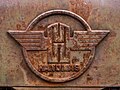
The 1952 integration into the Rheinstahl consortium produced a documented combined logo. This reflected the new corporate ownership while preserving the Hanomag name. The integrated branding appeared across various machinery lines until later ownership changes.
- Design: Combined Rheinstahl-Hanomag text in two-color format
- Colors: Two-color design suitable for industrial applications
- Changes: Logo modification directly linked to 1952 corporate merger
- Context: Represented the Rheinstahl-Hanomag era until the 1989 Komatsu acquisition
Modern Era: Komatsu Ownership
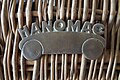
Komatsu acquired majority ownership in 1989 and full control in 2002. The independent Hanomag logo was gradually phased out in favor of the parent company branding. Historic Hanomag designs remain preserved mainly for heritage items and collector interest.
- Design: Transition away from standalone Hanomag branding
- Colors: Shift toward Komatsu corporate colors
- Changes: Complete ownership transition in 2002
- Context: Final phase of Hanomag logo evolution under new corporate structure
The Hanomag logo history reflects major corporate milestones from the 1871 renaming through the 1924 tractor launch, 1952 Rheinstahl merger, and 1989 Komatsu acquisition. These events directly influenced when and how the Hanomag emblem appeared on vehicles and machinery. Today the brand serves as a reference point for collectors of vintage German industrial logos and tractor emblems.