Key facts
- Founded
- 1958
- Founded by
- Beijing Municipal Government
- Country
- China
- Headquarters
- Beijing, China
- Legal name
- Beijing Automotive Group Co., Ltd.
- Famous models
- BJ40, BJ80, X7, U5 Plus
- Website
- www.baicgroup.com.cn
BAIC Group Brand Overview
BAIC Group traces its roots to Beijing Automobile Works, founded in 1958 under the Beijing Municipal Government. The plant built China’s early Jeep-style off-roaders and, through the following decades, grew into the city’s main state-owned vehicle maker, producing trucks, buses and military vehicles alongside passenger cars.
The group spent the ensuing decades consolidating Beijing’s various car ventures, including the Beijing Jeep and Beijing Hyundai joint ventures, under one holding company, Beijing Automotive Industry Holding Co., Ltd. On September 28, 2010, that holding company renamed itself Beijing Automotive Group Co., Ltd., the name it still carries, and on the same day set up BAIC Motor Co., Ltd. as its main passenger-vehicle subsidiary. In 2009 BAIC had bought technology rights from Saab Automobile, then a General Motors subsidiary that GM was in the process of selling off, covering three vehicle platforms including the 9-3 and 9-5 architectures, two engine designs and two transmissions. The first car built on that technology, the Senova C70, launched in 2013.
BAIC Motor was listed in Hong Kong in December 2014. Through BAIC Motor and other units, the group built joint ventures with Hyundai and with Mercedes-Benz parent Daimler, sells vehicles under the Beijing, Arcfox and Foton names, and by the mid-2010s ranked among China’s largest automakers by volume, appearing on the Fortune Global 500 list. In July 2019 BAIC Group bought a 5 percent stake in Daimler AG, and by December 2021 had raised it to 9.98 percent, becoming the German company’s largest single shareholder.
A separate company also called Beijing Automobile Works Co., Ltd. exists today, built around the historic truck and off-road business; BAIC Group sold its stake in that company in 2020, and the two are now unrelated. This page covers BAIC Group, the Beijing state-owned holding company behind the Beijing, Arcfox and Senova car brands, not that separate BAW company.
BAIC Group remains state-owned, controlled through the Beijing Municipal Government, and is headquartered in Beijing. Its passenger-vehicle lineup includes the BJ40 and BJ80 off-roaders sold under the Beijing brand and sedans such as the X7 and U5 Plus.
BAIC Group Logo Meaning
The oval badge BAIC used from 2010 to 2024 was built around the Chinese character 北 (bei, “north,” the first character of Beijing), stylized so its two strokes read as an open gate. BAIC described the design as symbolizing Beijing’s status as the capital and as an open door welcoming marketization and links to the wider world. Chinese car buyers nicknamed the badge “the pig nose” because of how it looked mounted in a grille, and the nickname stuck for years.
The current BAIC wordmark, adopted in 2024, spells out the company’s English initials in a single flat red stroke, with the B and A built from simplified, angular strokes. BAIC has described the redesign as a move toward a simpler, more recognizable mark suited to digital communication, dropping the chrome oval and Chinese lettering of the earlier badge; the company has not published a letter-by-letter meaning for the new initials.
BAIC Group Logo History and Evolution
2010 – 2024: The “Beimen” Oval Badge
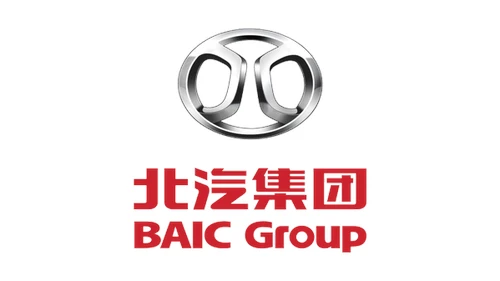
BAIC introduced this badge in 2010, the year BAIC Motor Co., Ltd. was formally established and the group renamed itself Beijing Automotive Group, and used it for about 14 years across the group and its Beijing-brand passenger cars. A chrome oval frames two teardrop shapes formed from the character 北, sitting above red Chinese characters and the “BAIC Group” wordmark. The three-dimensional metallic rendering was meant to project a modern, technology-driven image as the group expanded into passenger and electric vehicles. Online, the shape was widely mocked as resembling a pig’s nostrils, a nickname that followed the badge for its entire run.
2024 – present: The BAIC Wordmark
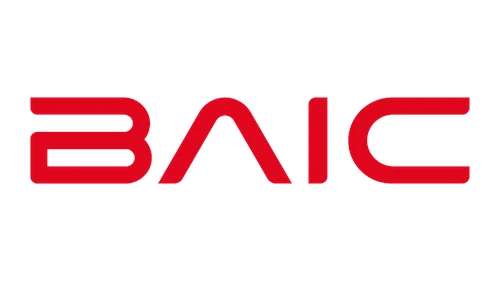
BAIC Group finalized its new corporate identity on August 11, 2024, and Beijing-brand cars followed with their own announcement on September 23, 2024, formally retiring the oval badge. The new mark drops the chrome oval and any Chinese lettering in favor of a flat red “BAIC” set in a single continuous line, with the B and A built from simplified, angular strokes. The redesign followed a wider trend among Chinese carmakers, including BYD, toward flatter, text-based logos, and it arrived as BAIC’s own Beijing-brand passenger cars were pushing to reverse several years of weak sales.
Who Owns BAIC Group?
BAIC Group is a state-owned enterprise controlled by the Beijing Municipal Government, which set it up in 1958 as Beijing Automobile Works. It is not privately owned or independently listed; instead, the group holds controlling or minority stakes in listed subsidiaries such as BAIC Motor, electric-vehicle subsidiary BAIC BluePark, and truck maker Foton Motor, and it holds a large minority stake in Germany’s Daimler AG. Zhang Jianyong has served as BAIC Group’s chairman since 2024.
FAQ
What does the BAIC logo mean?
The current red “BAIC” wordmark, introduced in 2024, is a simplified, flat lettering style meant to read clearly on screens; BAIC has not published a specific meaning for the individual letters. The earlier oval badge, used from 2010 to 2024, was built from the Chinese character for “north” and was meant to look like an open gate symbolizing Beijing and openness to the world, though it became better known online as the “pig nose” logo.
Who founded BAIC Group?
BAIC traces back to Beijing Automobile Works, founded in 1958 by the Beijing Municipal Government. The modern holding company, BAIC Group, took shape through later restructurings and still belongs to the Beijing city government.
Is BAIC the same company as BAW?
Not anymore. Beijing Automobile Works became a BAIC subsidiary in 2010, but BAIC Group sold its stake in 2020, and BAW is now a separate, privately owned company that builds trucks and off-road vehicles, including the 212 brand. BAIC Group has publicly stated the two companies share no ownership or property ties today.
Who owns BAIC Group?
The Beijing Municipal Government owns and controls BAIC Group. The group in turn owns stakes in listed units such as BAIC Motor and Foton Motor, and it is one of the largest outside shareholders in Mercedes-Benz parent Daimler AG.
Why did BAIC change its logo in 2024?
BAIC Group and its Beijing-brand passenger cars replaced the 14-year-old oval “pig nose” badge with a flat red “BAIC” wordmark in 2024, moving away from a design that had drawn years of online mockery and toward a simpler mark meant to signal the group’s technology and electric vehicle ambitions.